
By Terence Gower
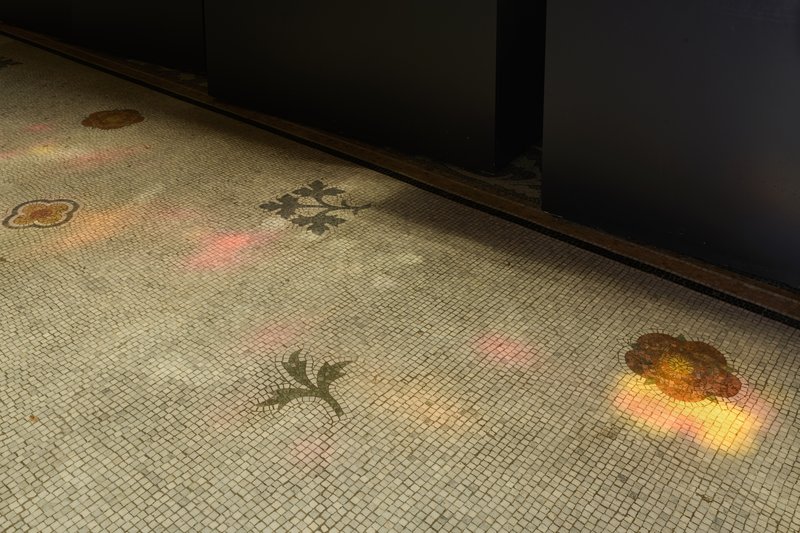
Voices in space. Enemies and Rascals is an immaterial work, where spoken phrases are carefully grouped like a collection of artefacts on display. We are in an archive storage room, but the shelves are empty. Where did the archive go? Are we hearing the voices of the missing documents, the echo of letters, speeches, and proclamations that once filled the room?
The central theme of this project is the early formation of two political entities, Canada and the United States. Their identities were galvanised by the conflict that is recounted by the many letters, addresses, and proclamations written or transcribed by people on the ground at the time. These are read by contemporary actors and played back in the archive room as the audio work Enemies and Rascals. This story is framed by recorded observations and critical commentary from the Indigenous inhabitants of the continent in the same period. This commentary is excerpted from period colonial transcriptions of Indigenous speeches and statements. The First Nations had different levels of involvement in the conflict, with many remaining neutral. But their interests were not protected by their allies on either side, and of all parties, they ended up having the most to lose.
The action takes place in North America. Nouvelle France (also called Canada) was ceded by the French in 1763, and renamed Quebec by the British. That same year, King George III proclaimed that a vast territory at the centre of North America would thenceforth be reserved for the First Nations, limiting the westward expansion of the Thirteen Colonies (the future United States). Ten years later, a British Act of Parliament [1] introduced new rules of governance for its new colony, enacting French civil law, allowing free practice of the Catholic religion, and attaching the territory proscribed by the 1763 Proclamation to the Province of Quebec. But speculators in the Thirteen Colonies had already been buying and selling land in that territory. To validate those transactions and secure future access to that land, the newly formed Continental Congress endeavoured to draw Canada into the political block of the Thirteen Colonies, at the outset of their fight for independence. The majority of Canadians declined the invitation to join, so Congress launched an invasion in the summer of 1775. The occupation of Montreal and the Siege of Quebec followed that autumn and winter, with the new Continental Army declaring they were “liberating” the Canadians from the British. This conflict and its declared motives are at the centre of this work’s narrative. The invasion was the first large-scale military operation of the War of Independence. That war ended with the 1783 Treaty of Paris, the loss of protections for the First Nations, and the incorporation of their territory into the new United States.
We artists are not historians, but we might appropriate some of the strategies of the historian and incorporate them into our practice. When I approach a historical subject, I try to find out what happened and what the motivations were, while maintaining a healthy degree of scepticism. To do this, I look for documents written by the people involved. The original challenge I set myself for this project was to assemble the narrative of this intercolonial conflict in North America using only documents held by the National Archives in Britain. But as I sought to bring in more voices from the Thirteen Colonies, I went to archives in the United States and Canada. The narrative nonetheless is composed exclusively of documents generated at the time the action takes place, from 1775 to 1776, plus a few documents providing some backstory in the 1760s.
Because of the global centralisation of the British Empire, much of the documentary evidence of what went on in 18th-century North America ended up in Britain. Enemies and Rascals is therefore a site-specific installation in London but about another place, 5,000 kilometres away. The story of how these documents, as artefacts, got to London is interesting in itself. All movement by people or documents in the 18th century from North America to Britain was by sailing ship. Important correspondence could be held up for weeks, or even months, by the wind. Or a packet-ship could be kept in port for a week or two so that a provincial governor could finish his letters to London, or wait for the transcript of a treaty negotiation to make its way from the western frontier to the Atlantic coast. Sometimes ships went down and the chain of correspondence was broken. Here is General Haldimand to Governor of Quebec, Sir Guy Carleton, Quebec, 22 June 1782:
Your Excellency’s Letter of the 5th of April from England has not appeared, and I much fear it has shared the fate of others in the Bellona, which after a fortunate passage to the South Traverse, there struck upon a rock and went down so soon as to leave the Crew only time to escape with their Lives. [2]
People had a different concept of time in the 18th century, not only through waiting for correspondence to arrive over the course of weeks, but also in the hours spent writing the letters, something hard to imagine in our era of quick-fire messages and instantaneous communication. An official letter might begin with a long preamble, such as:
Sir, Your Dispatch No. 61 has been received and laid before the King, and I am commanded to signify to you His Majesty’s entire approbation of the attention you appear to have given to every part of the important service under your superintendence. [3]
Sometimes a document describes its own circuitous route to enter the archive. Canadian militiaman Thomas Ainslie’s chronicle of the Siege of Quebec was written from inside the walls of that town. An invaluable testimony of events, it is now held in the Harvard University archive. When the Siege of Quebec was broken with the arrival of fresh British troops on 6 May 1776, Ainslie’s militia was tasked with pursuing the fleeing rebel army. He describes clothing, provisions, and papers left strewn on the ground at the rebels’ panicked retreat. A Northern Irish officer, Captain John Maxwell, was stationed with the British Army in Quebec City, and made those papers his personal property. These important artefacts of the invasion of Canada are now held by the Public Record Office in Belfast, donated by Maxwell’s descendants. The capitulation of Richard Montgomery (Brigadier General in the Continental Army) to Guy Carleton is held there as a manuscript copy, the original having been burnt.
The back-and-forth correspondence between Britain and its colonies was stored in a number of sites around Whitehall, before making its way to the new Public Record Office in the 1850s. Seventeenth- and 18th-century correspondence was generally bound in volumes stamped with the name of the pertinent government department. That correspondence is now stored at the National Archives complex in Kew. Other documents, pamphlets, proclamations, studies, surveys, lists, etc, were often bound together in volumes, similarly stamped. These were placed in what would later become the library of the Foreign, Commonwealth & Development Office, much of which was transferred to the Foyle Special Collections Library in 2007, and are thus kept today in the former Public Record Office building, now the Maughan Library of King’s College London.
George Bancroft was a historian from the United States who spent three years in London in the 1840s. He took advantage of his stay to transcribe a huge body of archival material dating to the War of Independence, its lead-up, and its aftermath. These manuscripts fill three hundred volumes held by the Special Collections of the New York Public Library. Bancroft’s gift has made a large part of the London colonial archive available to scholars in the United States. Another trove of colonial documents was left behind in North America as Britain debarked its army and administration at the signing of the 1783 Paris Treaty, which officially ended the War of Independence. These papers document the withdrawal of the British, and were ceremoniously offered to Queen Elizabeth II during a royal visit to the US in 1957. They are now held by the UK National Archives. [4]
Aside from being lost at sea or delayed by winds or wars, paper documents are susceptible to humidity, decay, fire, and even rodents. Paper and parchment documents were threatened or lost in these ways in the early days of record storage in London, before the creation of the Public Record Office. Fire was a hazard, especially when started deliberately. Richard Montgomery’s capitulation letter found its way into the Belfast archive, but the original was burnt. In the document quoted in Enemies and Rascals, Guy Carleton says, “Such will be the fate of all other embassies, unless they come to beg the King’s mercy.” [5] We can imagine him with a lit match held to Montgomery’s letter. Carleton’s radical policy was to burn all “rebel” correspondence without reading it. Then, at the end of his life, he burnt all his own correspondence, depriving future researchers of insight into his life and motivations. Thankfully, his administrative and military papers ended up safely stored at the Public Record Office, Britain’s first purpose-built fireproof building.
Nearly everything I’ve mentioned so far concerns colonial administration, including the correspondence and instructions sent back and forth between the North American colonies and the mother country, Britain. Those colonies were established on the land of North America’s First Nations, either through treaty, land grants, or seizure. The voices of the First Nations are also transcribed and preserved in the colonial archive. Some of those documents can be heard read by the “narrator” in the audio work. These transcriptions were made during meetings between representatives of the First Nations and officers and administrators from Britain’s North American colonies, at their shared borders. The transcriptions feature detailed speeches that laid down the demands or grievances of the group represented, or, occasionally, a carefully worded pledge of friendship or alliance. The transcriber is sometimes identified: in two of the examples cited in Enemies and Rascals, one is a reporter and the other a clergyman. Both were known partisans of the Thirteen Colonies, and it may be assumed that each had a vested interest in what was, or wasn’t, recorded (or remembered).
In the early centuries of the colonies in North America, colonial observers described the process by which important treaty negotiations and agreements were recorded and preserved by Indigenous groups. [6] Typically, male chiefs were given the role of spokesmen, and sat facing the colonial negotiators within a semicircle of women, who in turn were surrounded by their children. The women memorised what was said, and passed that information on to the next generation, who passed it on to their children. This memory-archive, if I may call it that, has been kept in the collective memory of the group, carefully memorised by each generation. It can’t be burnt, nor can it be eaten away by mould or damp.
Voices that are rarely found in the archive are those of the tenant farmers in Quebec’s feudal system. In the 18th century, most did not write, and so the actions and opinions of this population, by far a majority of the province, must be gleaned from the writing of colonial administrators, Catholic clergymen, or the noblesse, all of whom had a vested interested in presenting their own views of the habitants. The most useful document I found in the archive is from a foot soldier in the Continental Army’s invading force, who lodged with a Quebec farming family. His comparisons between the Quebec farming practices and his own are invaluable. [7] The document offers heartening insight into the human bond between so-called “enemies”, each having been enlisted or coerced into doing the bidding of their wealthy and powerful leaders.
And finally, the title. When the Continental Army crossed the border into the Province of Quebec and occupied Montreal, the Connecticut general David Wooster was appointed governor of that city. He was older than Montgomery, and an unpopular ruler. The Quebec habitants were selectively supportive of the invaders (as in the case just described), while the noblesse and the clergy were strongly opposed. The traders from Britain and the Thirteen Colonies were enthusiastically supportive of the idea of a larger North American union. Local Indigenous groups mostly tried to remain neutral – though, like the habitants, they faced constant attempts at recruitment from the British colonial military authorities on one side, and the rebels from the Thirteen Colonies on the other. In other words, occupied Montreal was a great ideological mix. Wooster retaliated against the Catholic Church by selectively forbidding masses, and he imposed unpopular taxes on the Montrealers, to cover the expenses of its occupiers. After months of local resistance and intrigue, he was at the end of his tether. At a meeting with some petitioners who had requested a hearing, he lost his composure and screamed, “I regard the whole of you as Enemies and Rascals!” [8]
We can imagine who the rascals were, but the enemies are more complicated. “Enemy” is a military term used throughout the correspondence in this conflict, and is common in all colonial or imperial parlance. For years I’ve been interested in the condition of the “invaded” party in conflicts such as this. What offence did these people commit to become enemies? Their offence was to simply be in the way of someone else’s interests, whether land, trade, or resources. “Enemy” is the term used to motivate soldiers to attack those people, who may respond as Carleton did, asking, “Why did you come to disturb an honest man and his government, that never did you any harm in his life?” [9] These are the words of a British colonial governor in Quebec City, berating the Continental Army as it crosses the border into Canada. Now imagine this comment delivered by the Marquis de Vaudreuil, governor of Nouvelle France, as Major-General Wolfe and the British Army surround the walled city of Quebec in 1759 (assisted by Guy Carleton, interestingly). Now go back further and picture the Saint Lawrence Iroquois directing this comment at Samuel de Champlain, as he stakes out Quebec City on their land in 1608. Why did you come? Perhaps the answer can be found in the archive, though it may not give us the whole story.
The hazards of the archive, both natural and man-made, mean that the archive is never complete. Aside from those lacunae just mentioned, can we trust the writer who took the dictation of the letter, or transcribed the speech? Over the years, these written fragments have been collected and arranged (and rearranged) into different historical narratives, often in the service of national myth-making. This has been one of my principal observations as I’ve compared the archival documentation with the many histories of these events, written in Britain, Canada, or the United States. This project is one such arrangement. It’s the product of what I’ve come to call “wild scholarship”, a creative act consisting of the appropriation, plus the necessary interrogation, of history writing.
[1] The Quebec Act was signed into law by King George III on 22 June 1774. An exhibition of bound volumes and maps on the Quebec Act are on display concurrently with Enemies and Rascals in the Maughan Library’s Weston Room.
[2] General Haldimand to Sir Guy Carleton, Quebec, 22 June 1782, SPO, vol. 132, no. 1, America and West Indies Collection, National Archives, London.
[3] Secretary Hillsboro’ to General Gage, 19 July 1771, vol. 12, no. 361, Bancroft Collection, New York Public Library Special Collections, New York.
[4] Collection PRO 30/55, National Archives, London.
[5] William William (Lieutenant in the British Militia), “Narrative of the Invasion of Canada by the American Provincials under Montgomery and Arnold, with a Particular Account of the Siege of Quebec”, The Canadian Review and Magazine 3, no. 5 (1826).
[6] Bruce Johansen describes this process in detail, paraphrasing Benjamin Franklin, who was present at a meeting in 1774. In Franklin’s words, “Women … are the Records of the Council.” Bruce Johansen, Forgotten Founders: Benjamin Franklin, the Iroquois, and the Rationale for the American Revolution (Boston: The Harvard Common Press, 1982), 57.
[7] “They raise near as many sheep as we do among us and all as good or better. And much more poultry of all kinds, particularly turkeys.” Anonymous manuscript diary of Montgomery’s Quebec campaign, November 1775, MssCol 2701, Philip Schuyler Papers, New York Public Library Special Collections.
[8] Simon Sanguinet, “Journal”, in Invasion du Canada: Collection de mémoires recueillis et annotés, ed. Hospice Anthelme Baptiste Verreau (Montreal: E. Senécal, 1873), 95.
[9] Guy Carleton, quoted in Charles Henry Jones, History of the Campaign for the Conquest of Canada in 1776 (Philadelphia: Porter & Coates, 1882), 46. (The writer’s grandfather fought in the Siege of Quebec.)
Photography by Thierry Bal