
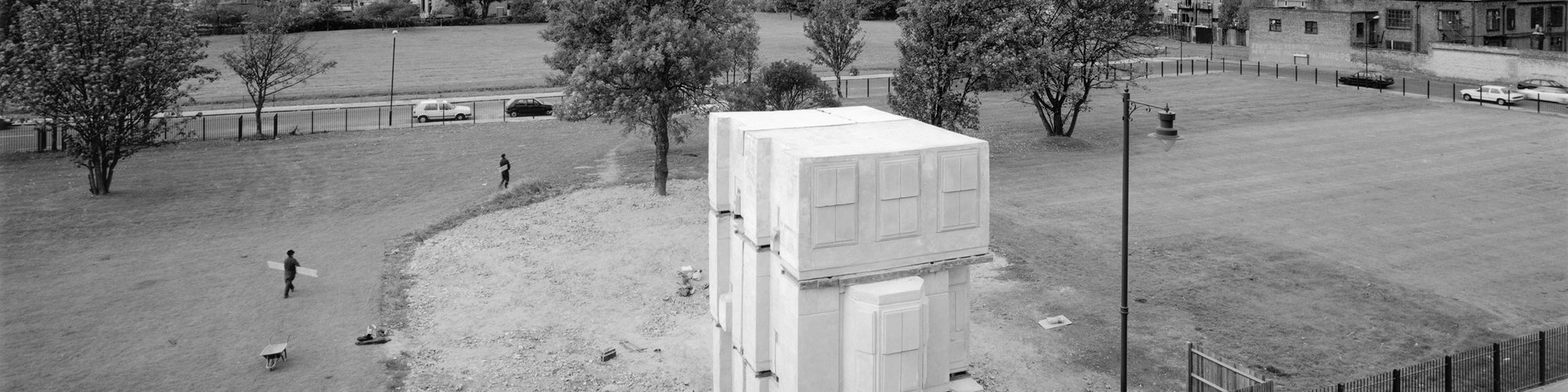
Denatured by transformation, things turn strange here. Fireplaces bulge outwards from the walls of House, doorknobs are rounded hollows. Architraves have become chiselled incisions running around the monument, forms as mysterious as the hieroglyphs on Egyptian tombs. — The Independent
The Construction of House
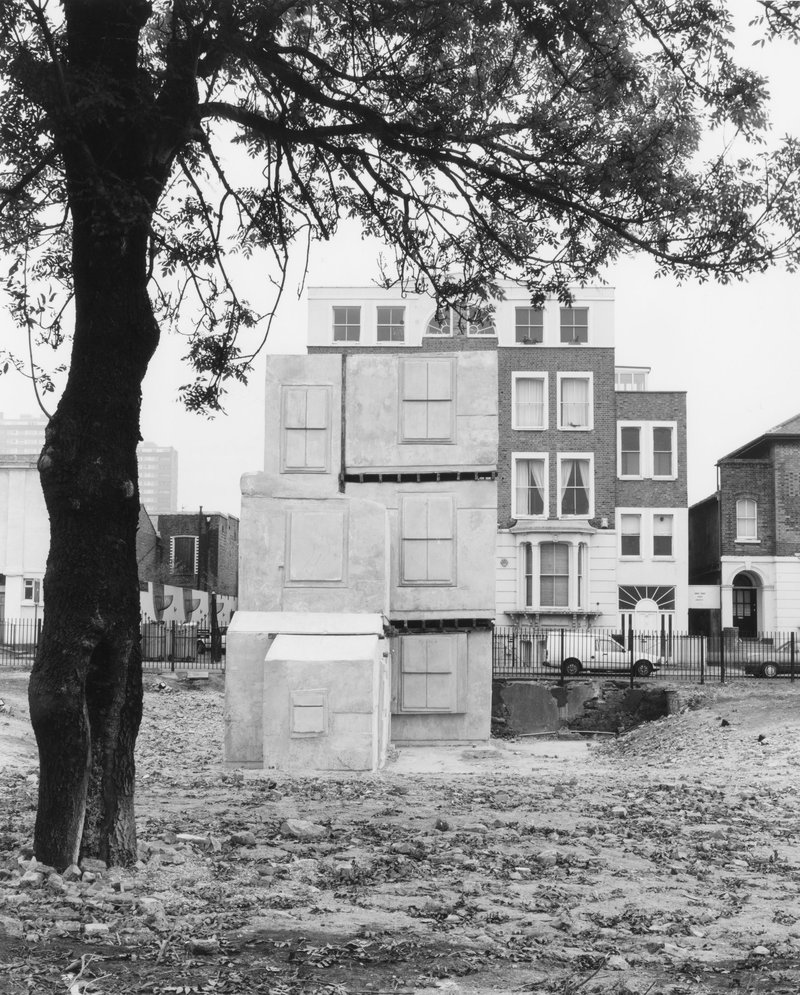
In 1993, House was Rachel Whiteread's most ambitious work to date. Like many public sculptures and memorials, House was a cast. But unlike the bronzes which commemorate triumphs and tragedies, great men and heroic deeds, House commemorated memory itself through the commonplace home. Whiteread's in-situ work transformed the space of the private and domestic into the public — a mute memorial to the spaces we have lived in, to everyday existence and the importance of home.
Making House
By James Lingwood
It began, an idea without a name, in the quiet of Rachel Whiteread's studio in East London. And it ended several years later, a sculpture called House, demolished in the full glare of the world's media. House always had the potential to be a contentious work of art. But in my first conversations with Rachel Whiteread in the summer of 1991, it was impossible to imagine that it would be quite as exposed, quite as contentious as things turned out; and that its transition from private projection to public phenomenon would be so dramatic and so quick.
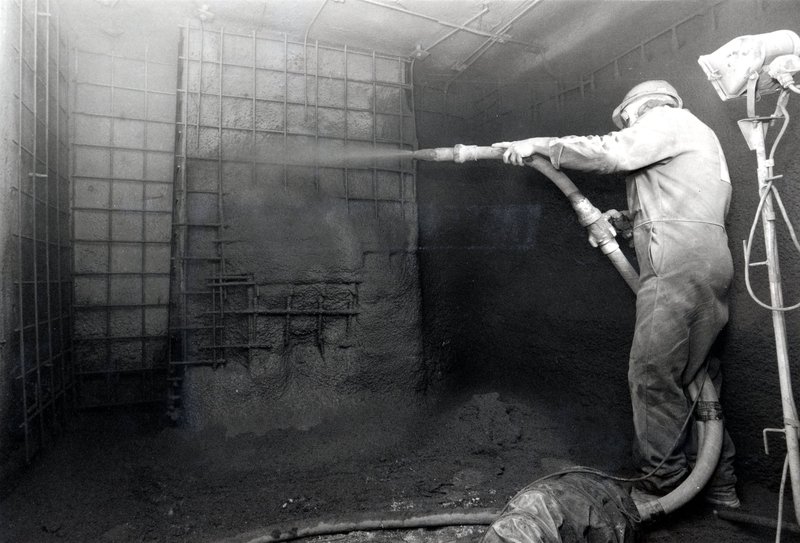
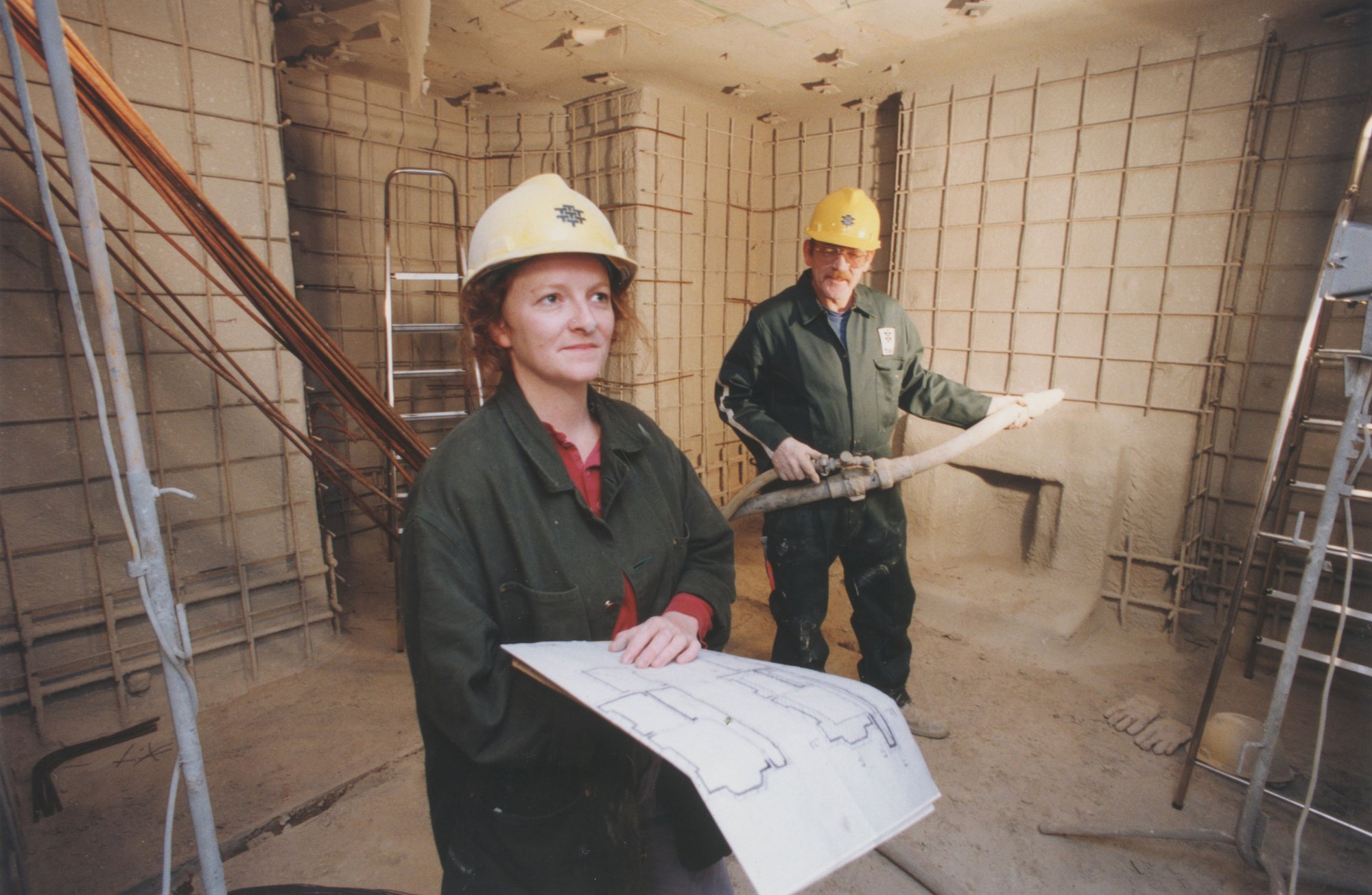
The house was carefully coated in a de-bonding membrane and then splatter-gunned, room by room, with two layers of concrete - fine white Locrete (used on the white cliffs of Dover) and then 10cm of mesh-reinforced concrete, with special reinforcing bolts at the corners. The external interior was gradually sealed up, the last person leaving through the roof.— Kester Rattenbury, Building Design, 29 October 1993
The House in the Park: a psychogeographical response
By Iain Sinclair
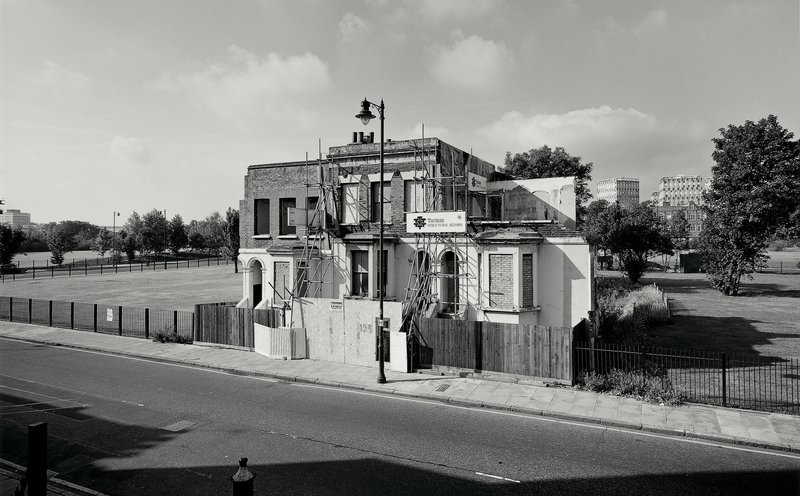
'What did your street look like in the past?' One of the more useful ephemerals of the heritage industry is the Godfrey Edition of Old Ordnance Survey Maps: a largely Victorian patchwork intended for those 'who wish to explore London and its history'. A canny piece of merchandizing to set alongside the repair and enlargement, in authentic sepia, of retrieved family photographs (not necessarily your own family); a painless method of acquiring a fraudulent pedigree, of airbrushing the warts of history and providing the hard evidence of a past that never existed. The folded scarlet repro featuring Bethnal Green & Bow (1894) nominates, as its cover illustration, a postcard of the Royal Hotel, Grove Road. (A slightly odd choice given that the hotel is in South Hackney and barely ducks under the cut-off line at the top of the map.)
Be part of the extraordinary
Help Artangel continue to make extraordinary art like Rachel Whiteread's House possible. Join our community of supports or donate today.
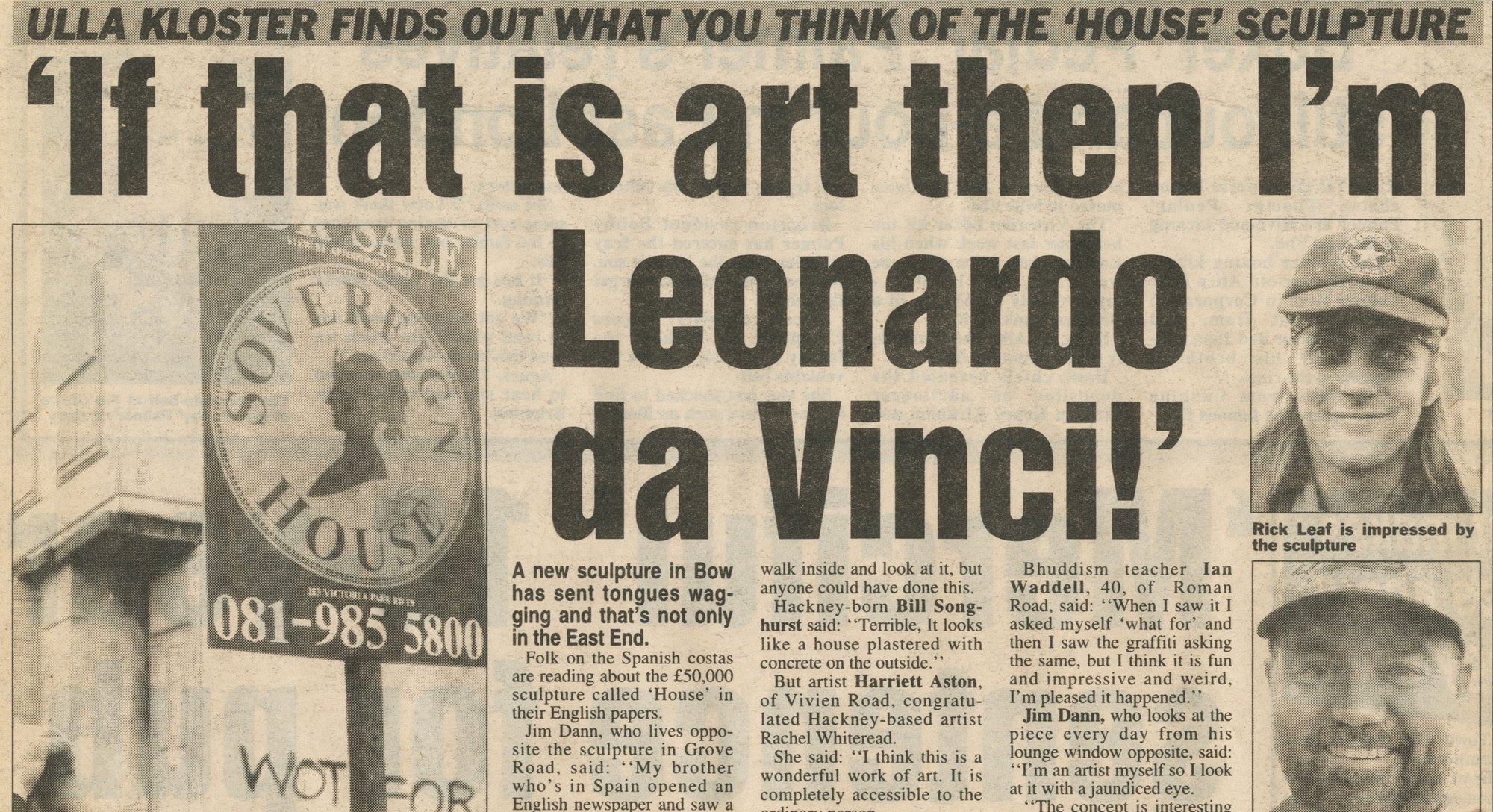
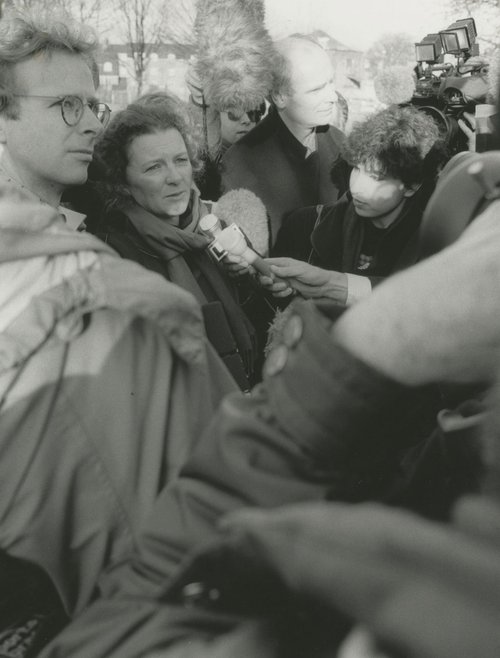
It would be disingenuous to claim that House excites universal acclaim - locally or nationally. Clearly it attracts hostility and indifference as well as support. But it is more disingenuous to claim that there is no local interest. Local builders have called the sculpture 'amazing', people living across the road have said it is 'impressive' and 'wonderful''; a local resident said on Thursday that 'it should stay for future generations to remember what it was like here'. Rachel Whiteread was approached by two locals who had lived in the now demolished terrace for 40 years and thanked for 'making their memories real'. [...] The success of this sculpture has been to fracture the normal stereotypes of opposition and support. It is simply not a case of 'them' against 'us', local against national. The hunger to erase House so quickly masks an insecurity about the potential for art to communicate in ways which are unheralded and unpredictable. — James Lingwood, The Times, 27 November 1993
Selected Press
To visit House … It is to be taken to another world, like and yet completely unlike this one: the world of the photographic negative, with its phantom-like reversals of known fact; the world that Alice enters through her looking glass; the world that lurks behind the molten silver mirror in Cocteau's Orphee, where normal relations between objects have been summarily suspended. Denatured by transformation, things turn strange here. — Andrew Graham-Dixon, The Independent, 11 November 1993
A remarkable monument, it triggers a fascinating variety of responses from viewers and passers by. A cast of the commonplace, it reverses the spatial relationships we are used to, but as soon as one has filed it under 'abstract form' out come all the evocative details calling for a naturalistic viewing mode and then the endless ripples of association of 'home' and of 'house' and of 'housing policy' and of 'lives'. — Art and Architecture, Autumn 1993
Artful lodger Rachel Whiteread is set to take the world of sculpture by storm - the canvas for her latest creation-in-concrete is a three-storey terraced house near Victoria Park… — Julie Coulson, Hackney Gazette, 29 October 1993
The house was carefully coated in a de-bonding membrane and then splatter-gunned, room by room, with two layers of concrete - fine white Locrete (used on the white cliffs of Dover) and then 10cm of mesh-reinforced concrete, with special reinforcing bolts at the corners. The external interior was gradually sealed up, the last person leaving through the roof. — Kester Rattenbury, Building Design, 29 October 1993
Standing revealed before us, our homes, secured at such cost, are proved to be poor crooked things, their mean interiors measuring out our days. That hopes and dreams and indeed art itself should emerge from these haphazard shelters is testimony to the human spirit, a worthy subject for a remarkable monument. — Lynn MacRitchie, Financial Times, 6 November 1993
I do not recall seeing a more ambitious piece of public sculpture in London than Rachel Whiteread's House. Situated in what is now a park in Bow, House is a plaster cast of the inside of the last terraced house in the street. This is a monument to the house that refused to become a park. As such, it is a monument to a certain kind of East End stubbornness that withstood wars, bombs, hunger, riots and assorted ethnic invasions but not the building boom of the 1980s. — The Sunday Times, 8 November 1993
Her work is about death, about attempting to define and encapsulate the past - as in her 'room' in the Tate, and the house in the East End, which stands monumental and poignant like a great white mausoleum for the collective memory of a dying way of life. — Sue Hubbard, New Statesman, 12 November 1993
Sir: It is to be hoped that Bow Neighbourhood Council is beginning to realise, from the enormous amount of interest that has been generated by Rachel Whiteread's sculpture "House", what an extraordinary piece of good luck has befallen it... Without commission, without cost and without a team of town planners, one of the most significant public sculptures of recent years has simply emerged in the council's brand new park. It is a once-in-a-lifetime gift that a thousand towns and cities across Europe would seize readily. — Tim Neilson (to the letters page), The Independent, 16 November 1993
Sir: We will be brave, Mr Neilson (letter, 16 November), we will be brave! We will be brave enough to ignore the fusillade of froth from the arts lobby and remove the monstrosity as soon as the contract allows... As far as I am concerned, any of the "thousands of towns and cities across Europe" that Mr Neilson feels would love to have House are welcome to it." Eric Flounders, Chair of Bow Parks Board (to the letters page), The Independent, 17 November 1993
In the East End of London, Rachel Whiteread's architectural sculpture, House, has been voted into destruction. House is a modern masterpiece. In it an ingenious idea is realised with great evocative power. Taking a derelict dwelling, Whiteread has turned it inside out by casting the interior in liquid concrete then removing the bricks. What is left is a monument to past domesticity, a coarse yet intricate edifice, alone in the space it once occupied with a hundred similar residences. It satisfies contemplative as well as aesthetic taste. Once seen, it makes you look at all houses in a new way. [...] On Tuesday night the Bow standing neighbourhood committee voted to pull House down. Six politicians, all Liberal Democrats, took the decision on the casting vote of the chairman, Cllr Eric Flounders... Cllr Flounders, a man apparently not without the outwards signs of education, called it "excrescent", and "a monstrosity", from the moment it was unveiled last month. He was determined to expunge it from Tower Hamlets at the earliest moment. — Hugo Young, The Guardian, 25 November 1993
It would be disingenuous to claim that House excites universal acclaim - locally or nationally. Clearly it attracts hostility and indifference as well as support. But it is more disingenuous to claim that there is no local interest. Local builders have called the sculpture 'amazing', people living across the road have said it is 'impressive' and 'wonderful''; a local resident said on Thursday that 'it should stay for future generations to remember what it was like here'. Rachel Whiteread was approached by two locals who had lived in the now demolished terrace for 40 years and thanked for 'making their memories real'. [...] The success of this sculpture has been to fracture the normal stereotypes of opposition and support. It is simply not a case of 'them' against 'us', local against national. The hunger to erase House so quickly masks an insecurity about the potential for art to communicate in ways which are unheralded and unpredictable. — James Lingwood, The Times, 27 November 1993
What I didn’t want is it to look like a derelict building. I wanted it to look far more purposeful than that. – Rachel Whiteread, interviewed by John Wilson for BBC Radio 4's This Cultural Life, 4 February 2023
A motion for House in Parliament
This House congratulates Rachel Whiteread on winning the Turner Prize as best modern artist of the year; recognises that good art is often challenging and controversial; believes it would be an act of intolerance and philistinism to destroy her sculpture in Grove Road, Bow before more people have had the opportunity to see it; and calls upon Tower Hamlets Council to allow it to remain for three months and during that time to consult local people about whether or not it should be destroyed.
This early day motion 109 was signed in the United Kingdom's parliamentary House of Commons on 25 November 1993 by MPs including Ken Livingston (future Mayor of London), Diane Abbott (still MP for Hackney North and Stoke Newington) and Jeremy Corbyn (future leader of the Labour party in opposition).
The Demolition
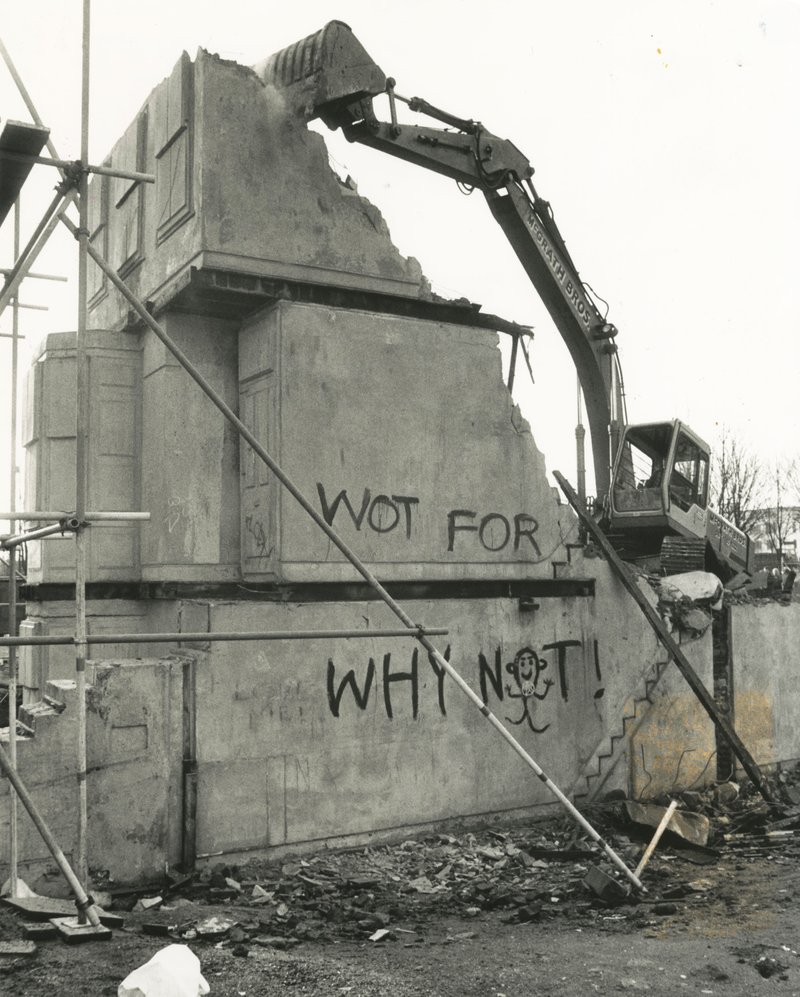
More than 100,000 people had seen House during its 10-week tenure of a patch of scrubby parkland at the junction of Roman Road and Grove Road in London E3, and a vigorous campaign - conducted largely within the pages of this newspaper - had been mounted to save it. But the implacable opposition of Bow Neighbourhood Council - whose land it occupied and whose leader, Eric Flounders, had publicly reviled the sculpture as 'utter rubbish' and 'a little entertainment for the gallery-going classes of Hampstead' - sealed its fate. Mr Flounders had huffed and he had puffed, and by 11am yesterday he had, finally, blown House down.
[Joe] Cullen, not a man of many words, seemed somewhat taken aback by the sudden interest shown in his attitudes to modern art. He had come to bury House, not to praise it. And preferably not even to discuss it. 'It's not art, it's a lump of concrete,' he told the world's press before climbing into the cab of his vehicle, where he evidently felt rather more comfortable.
A sort of time capsule, as much concerned with public reaction as with the artist's wishes and as such it will accumulate aura down the years. — Observer
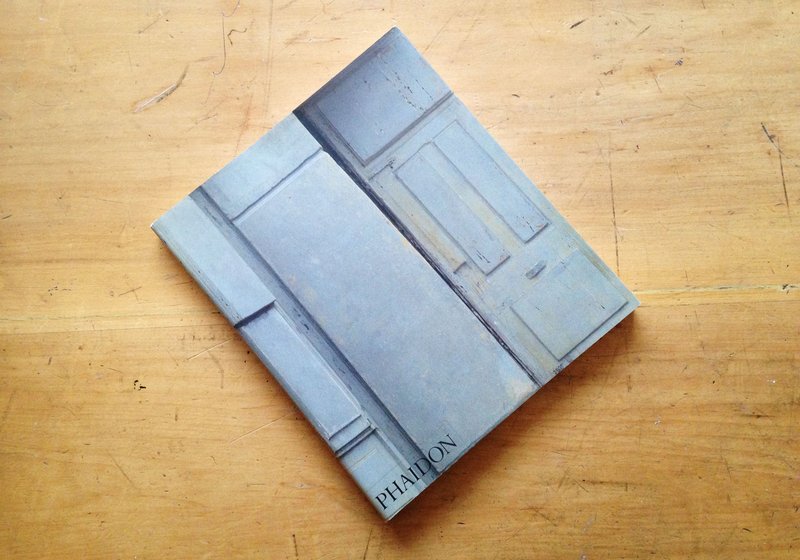
Featuring documentation of Whiteread's concrete and plaster cast of an entire house, this book provides a unique chronicle of this remarkable work. Photographs and working drawings chart the house's life from construction to demolition. Six key figures in art journalism contribute their thought-provokingly diverse responses: in turn, the book surveys the whole spectrum of critical reaction to the work.
Edited by James Lingwood, with essays by Jon Bird, James Lingwood, Doreen Massey, Richard Shone, Iain Sinclair, Neil Thomas, Anthony Vidler and Simon Watney
Published by Phaidon in collaboration with the Artangel Trust
ISBN-13: 9780714834597
ISBN-10: 0714834599
Rachel Whiteread
Rachel Whiteread
Rachel Whiteread was born in London in 1963. She studied painting at Brighton Polytechnic and sculpture at the Slade School of Fine Art. Whiteread’s breakthrough piece, Ghost, 1990, is a plaster cast of a living room, modelled on a typical Victorian terraced house, similar to the north London terrace in which the artist grew up.
Whiteread was awarded the Turner Prize in 1993 just after creating House under commission for Artangel. The life-sized replica of the interior of a condemned terraced house in London’s East End was made by spraying liquid concrete into the building’s empty shell before its external walls were removed. Whiteread’s winning proposal for the Holocaust memorial for the Judenplatz in Vienna, involved placing the cast interior of a library, including the imprint of books, in the centre of the square. It was unveiled in October 2000.
The artist represented the UK at the 1997 Venice Biennale and created Monument for the empty plinth in Trafalgar Square in 2001. In 2005, Whiteread created Embankment, which consisted of some 14,000 translucent, white polyethylene boxes (themselves casts of the inside of cardboard boxes) stacked in various ways, for the annual Unilever Series commission to produce a piece for Tate Modern’s vast Turbine Hall.
In 2008, the artist presented a new, larger version of her acclaimed installation Village, bringing together more than 200 dollhouses that the artist has collected over the past 20 years, for the acclaimed exhibition ‘Psycho Buildings’ at the Hayward gallery.
Whiteread lives and works in London and her work is represented in many private and public collections worldwide.
House was commissioned by Artangel with Beck’s. It was sponsored by Tarmac Structural Repairs. The sponsorship of Tarmac Structural Repairs is an award winner under the Business Sponsorship Incentive Scene. The BSIS is a Government scheme administered by ABSA, the Association for Business Sponsorship of the Arts. Structural and construction advice was provided by Atelier One.
Artangel is generously supported by Arts Council England and the private patronage of the Artangel International Circle, Special Angels, Guardian Angels and The Company of Angels. Further assistance on this project was received by The Henry Moore Foundation and the London Arts Board.



From the top:
- Rachel Whiteread, House (1993). Photograph: John Davies
- The remaining terraces of Grove Road, London E3, during early installation of Rachel Whiteread's House (1993). Photograph: John Davies
- Coating the concrete interior. Rachel Whiteread, House (1993). Photograph: Edward Woodman
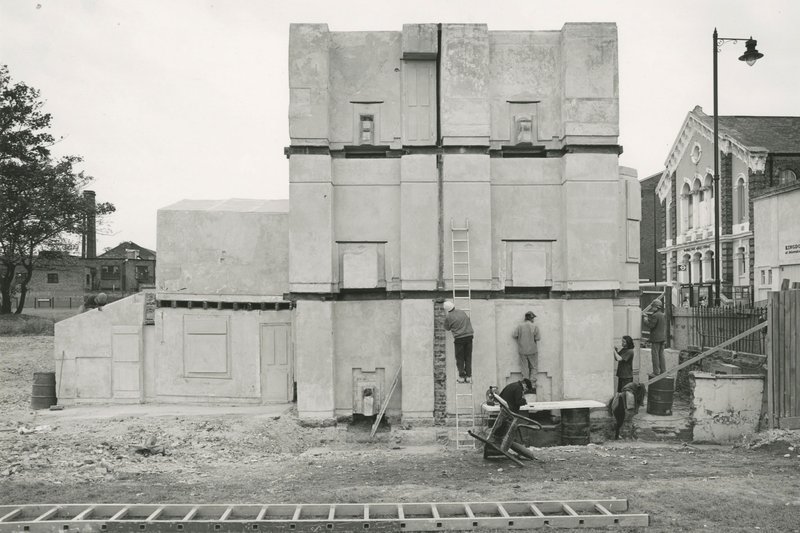
- Rachel Whiteread's House nearing completion (1993). One of the figures assisting in the construction of House was Michael Landy, the artist who created Breakdown (2001). Photograph: John Davies
- Rachel Whiteread, House (1993). Photograph: Sue Ormerod
- News clipping from an article by Ulla Kloster fielding "local opinion" in the East London Advertiser, Thursday November 4, 1993.
- Joe Cullen of Demo One Ltd (Demolition and Dismantling Engineers) atop his digger begins demolition of House after a significant press campaign failed to preserve the sculpture (1994). Photograph: Stephen White
- Rachel Whiteread inside House during construction. Rachel Whiteread, House (1993). Photograph: The Tarmac Group.