
Register your interest
Fill out the form to find out more about how you can borrow and present this work, including tech specs, use cases, and more.
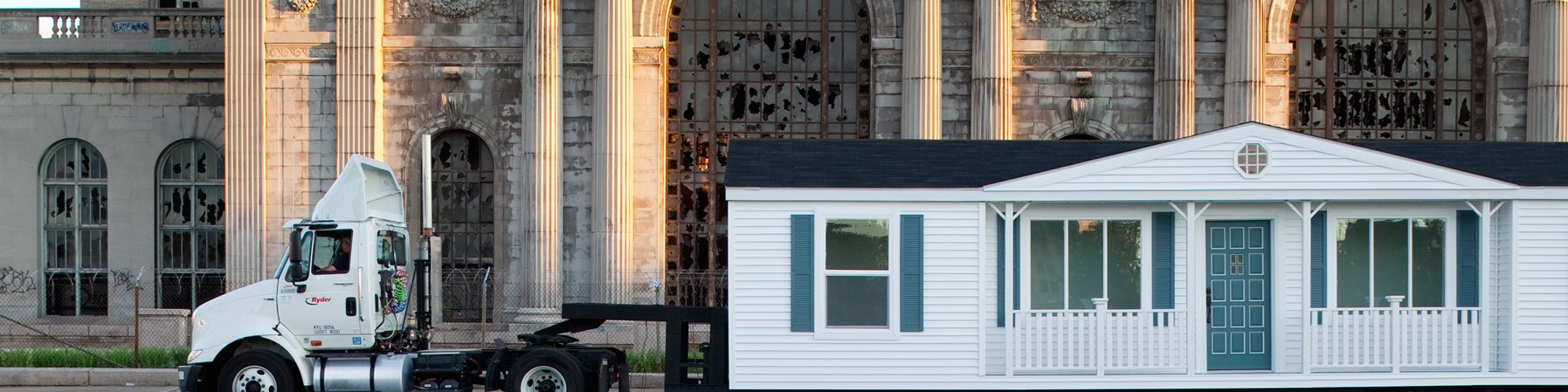
Mobile Homestead grew out of my initial desire to buy the actual house that I was raised in. The plan was to empty the house of furnishings and turn it into a neighborhood art gallery while, at the same time, I would secretly dig an underground tunnel system that would, in a haphazard manner, weave under the adjacent properties. – Mike Kelley
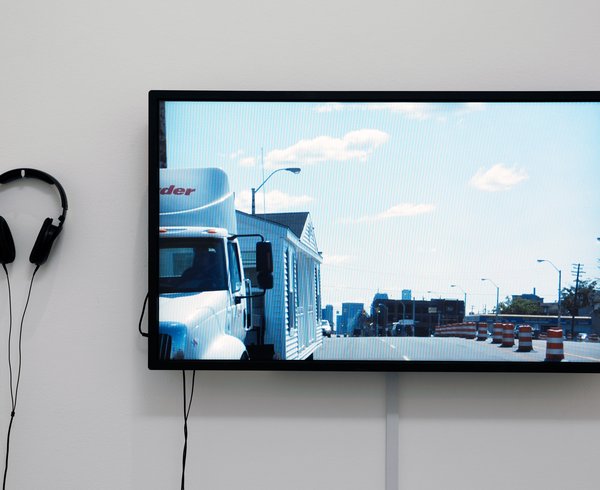
Audio: Mike Kelley in conversation with James Lingwood
25 minutes 41 seconds
Audio: Mike Kelley in conversation with James Lingwood
In 2013, on the occasion of a permanent installation of Mobile Homestead in Detroit, Artangel released this full interview between Mike Kelley and Artangel director James Lingwood, originally conducted in 2010.
This conversation is also available to listen to on Soundcloud.
Parts of it are also included in the podcast episode on memory, alongside reflections by artists Clio Barnard and Susan Philipsz.
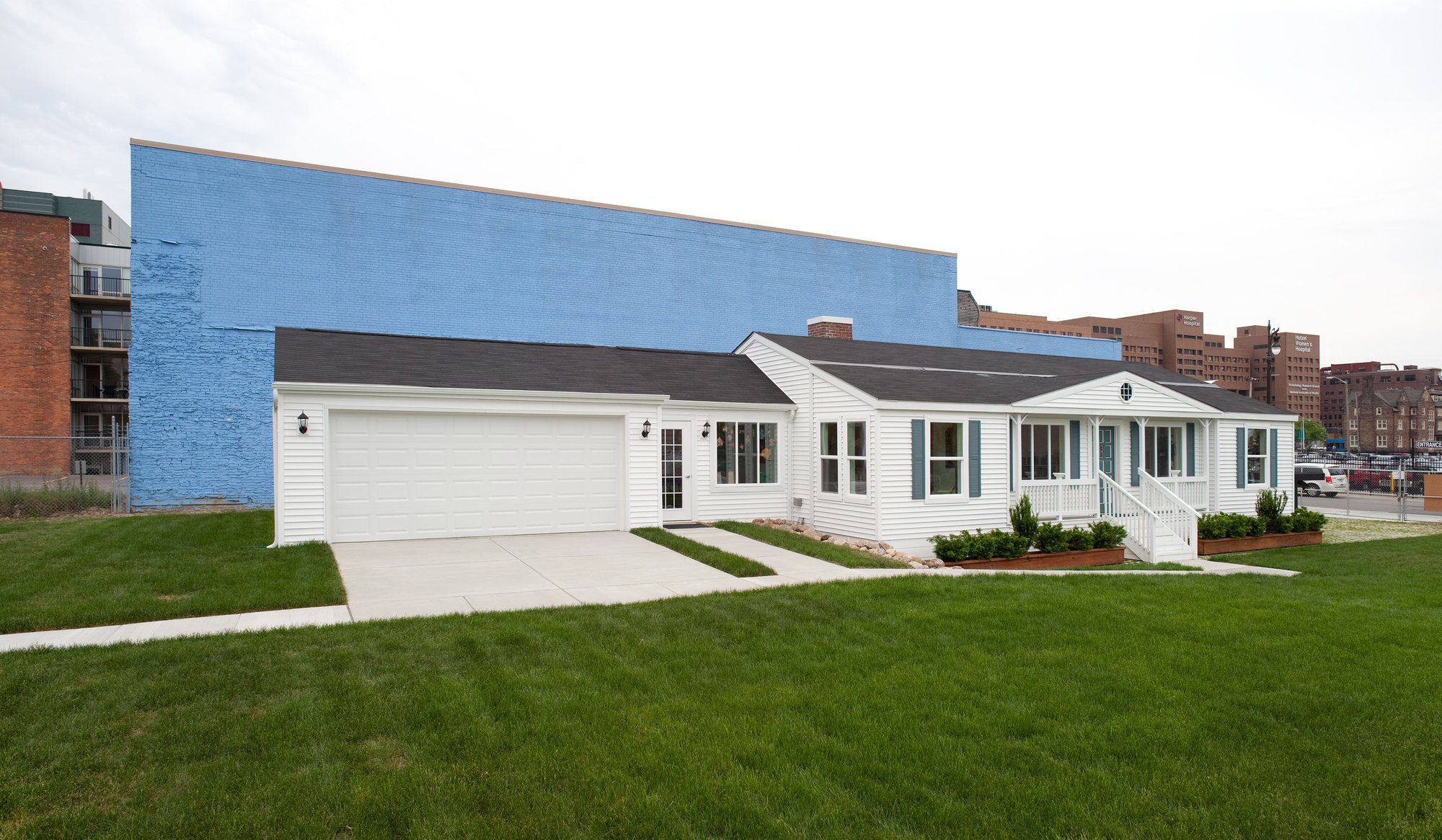
Image: Mobile Homestead permanently installed, Mike Kelley, 2013. Photograph: Jason Sudak. Courtesy of MOCAD
Detroit bites but good
By Toby Barlow, November 2010
Mike Kelley’s Mobile Homestead trailer began its scheduled journey at 2:05 pm on September 25. On the trailer sat a large recreation of Mr. Kelly’s childhood house. It planned to travel down Detroit’s Woodward Avenue and take a right onto Michigan Avenue. Then, after cruising past the strip joints, biker haunts, supermercados and Slows Bar-B-Q, the caravan would arrive at the site of the original home.
But this was just a spark in the greater zeitgeist. So much looms around Detroit now, filling the air with that great whooshing sound you hear as a predatory bird descends. As the trailer started up, David Byrne was just two miles away – one of 3,000 enthusiasts cycling the annual ‘Tour de Troit’. A week later Matthew Barney would stand atop the towers of an abandoned steelworks as a dismembered 1967 Imperial was melted in a burning forge. And just two days after that, Neil Young parked his 1959 Continental Convertible - reincarnated as a turbine powered electric vehicle – on the front lawn of Ford World Headquarters for an unannounced visit. All this creating a sense of some vast collective-unconscious art piece orchestrated by greater powers. Maybe. Maybe not.
It didn't matter. This is the town that eats its own. And the Kelley Kid was in for it, as if the psychic city had put a big red neon target on his back. Destiny’s black angel snipers leaned over the abandoned rooftops, angling for the kill.
Sure enough, coming around the corner onto Michigan, Mike’s trailer popped up onto the curb, banging a massive hole in the tire. The limping caravan stopped. A truck pulled up outside the Book Cadillac to assess the damage. People mulled about. It was bad. So many metaphors colliding, issues in housing, transportation, and culture – all piling up there on the front stoop of our finest hotel.
Mike Kelley
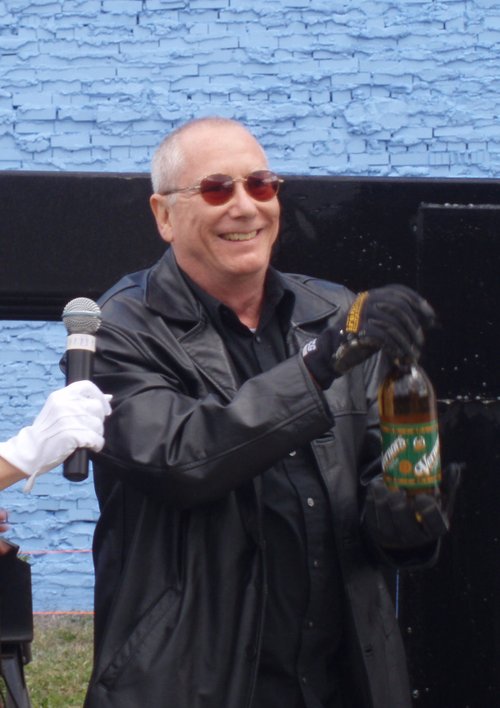
Mike Kelley
The work of artist Mike Kelley (1954 – 2012) embraced performance, installation, drawing, painting, video, sound works, and sculpture. Referencing both high art and vernacular traditions, his works drew from historical research, mass cultural references, and psychological theory. Beginning in the late 1970s with solo performances, image/text works, and gallery and site-specific installations, Kelley came to prominence in the 1980s with a series of sculptures composed of common craft materials. His most recent work addressed architecture and filmic narrative through the theory of repressed memory syndrome, and a sustained biographic and pseudo-biographic inquiry into his own aesthetic and social history.
Mike Kelley’s work has been the subject of numerous exhibitions including, most recently, Horizontal Tracking Shots, Gagosian Gallery, New York, 2009; Mike Kelley: Educational Complex Onwards: 1995-2008, WIELS Centre d'Art Contemporain, Brussels, Belgium, 2008; Life on Mars: 55th Carnegie International, Carnegie Museum of Art, Pittsburgh, Pennsylvania , 2008; Mike Kelley: Kandors, Jablonka Galerie, Berlin, 2007; Petting Zoo at Skulptur Projekte Münster, 2007; Profondeurs Vertes at the musée du Louvre, 2006; Day Is Done, a sculpture and video installation at the Gagosian Gallery, NY, 2005; The Uncanny, a curatorial project presented at the Tate Liverpool and at the Museum Moderner Kunst Stiftung Ludwig, Wien in 2004; a 1993 traveling retrospective of his work that opened at the Whitney Museum of American Art; Documenta IX (1992) and Documenta X (1997), in Kassel, Germany; five appearances at the Whitney Biennial; and many other solo museum and gallery exhibitions. He was a member of Destroy All Monsters, an improvisational noise band (featuring artists Cary Loren and Jim Shaw) which performed internationally and the visual art wing of the group, The Destroy All Monsters Collective, was featured in the 2002 Whitney Biennial. He published several volumes of critical writings, Foul Perfection: Essays and Criticism (2002), Minor Histories: Statements, Conversations, Proposals (2004), and Mike Kelley : Interviews, Conversations and Chit-Chat (2005) , a collection of Kelley’s interviews with notable contemporary figures.
Mike Kelley received a BFA from the University of Michigan, Ann Arbor (1976) and a MFA from the California Institute of the Arts (1978). His awards included The Louis Comfort Tiffany Foundation Grant, National Endowment for the Visual Arts Fellowships, the Awards in the Visual Arts grant, the Skowhegan Medal for Mixed Media, the Distinguished Alumni Award from the University of Michigan School of Art and Design, the Distinguished Alumnus/a Award from the California Institute of the Arts, and a Guggenheim Fellowship. Mike Kelley lived and worked in Los Angeles, California.
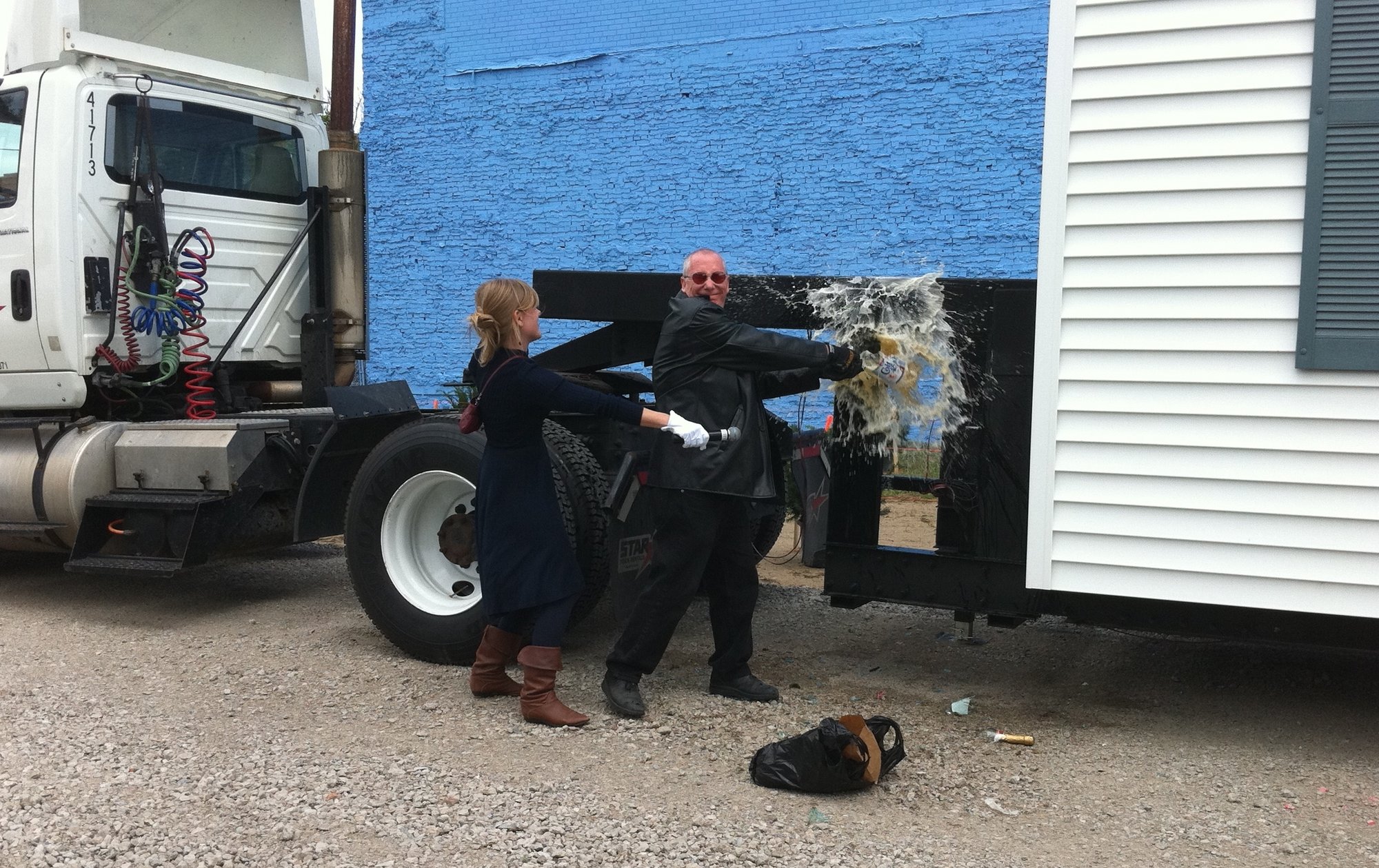
Images: Mike Kelley christening Mobile Homestead, 25 September 2010 (left) Photograph: Ronald Thibault; (above) Photograph: Cressida Day.
Credits
Commissioned by Artangel in association with the Mike Kelley Foundation for the Arts, MOCAD and the LUMA Foundation with the generous support of the Artangel International Circle. Community Programs are supported by the Robert Rauschenberg Foundation.
Artangel is generously supported by the private patronage of The Artangel International Circle, Special Angels and The Company of Angels.