
In The Artangel Collection
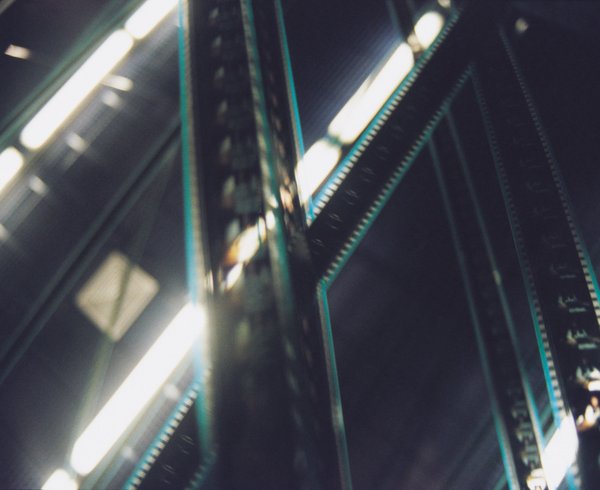
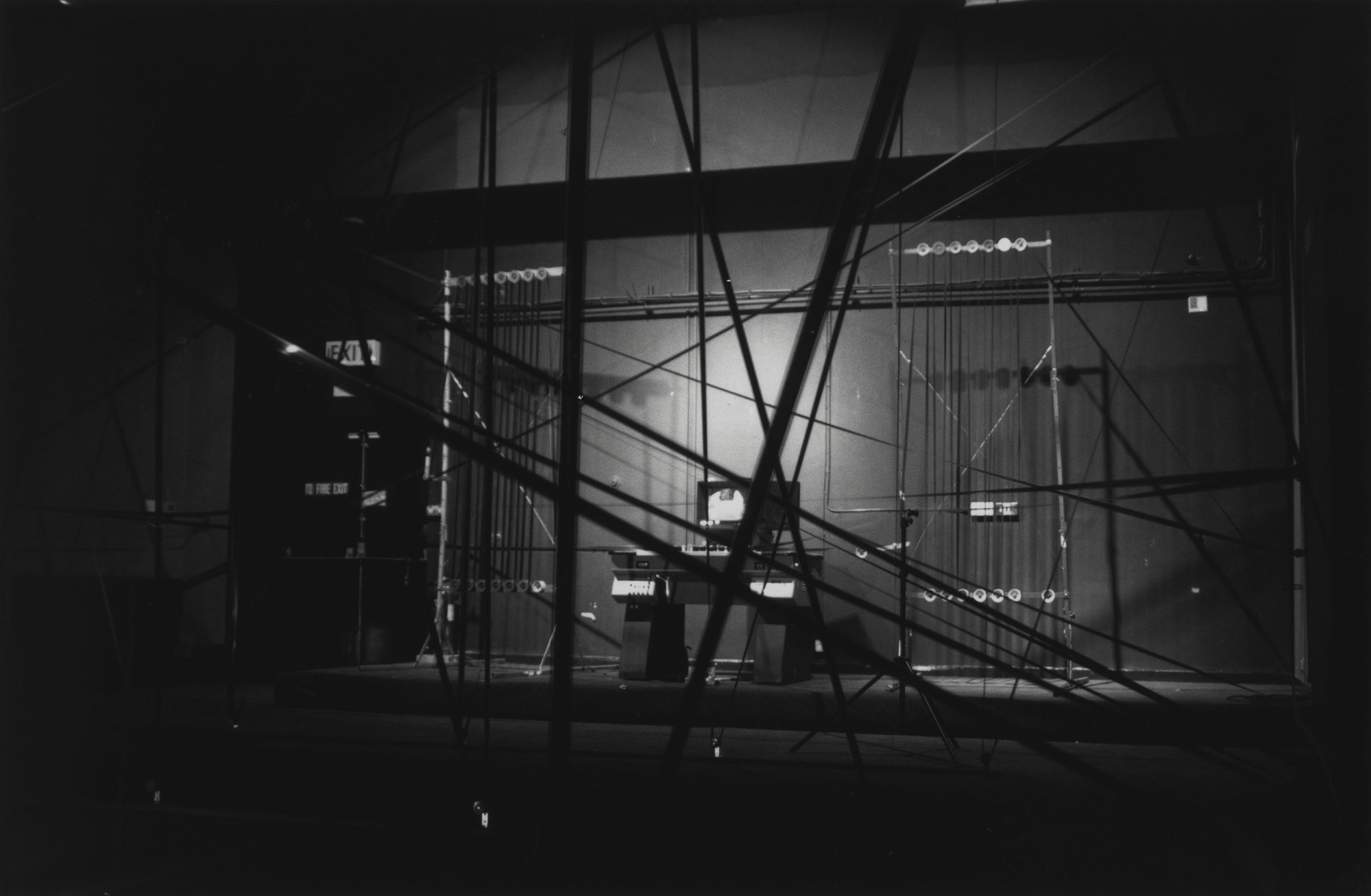
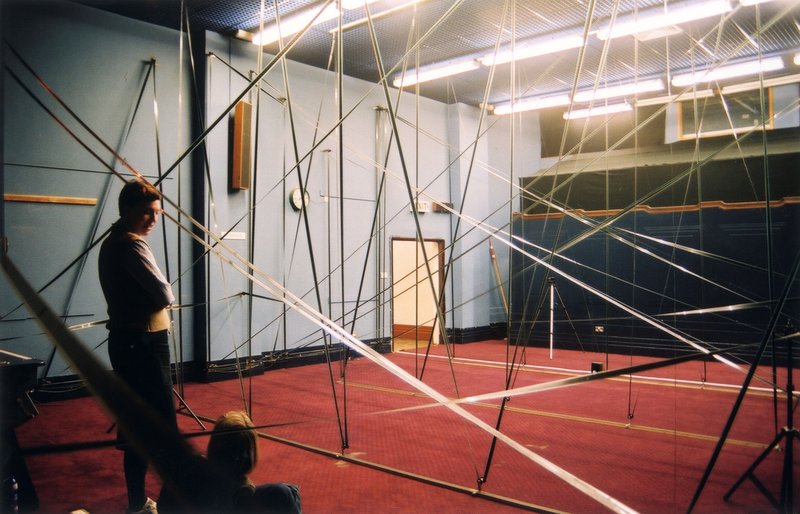
This intricate installation brings together 2000 feet of film, moving precariously and continuously around the room through pulley-suspended sprockets driven by a lone Steenbeck. While the film slowly degrades over time, shown in an adjoining room is the crisp digital presentation of the same footage—the last 20 minutes of Samuel Beckett's Krapp's Last Tape.
Register your interest
Fill out the form to find out more about how you can borrow and present this work, including tech specs, use cases, and more.
Making Steenbeckett
Atom Egoyan visited the Kabakov's Palace of Projects when he was in London working with Gavin Bryars on Doctor Ox's Experiment at the English National Opera. He seemed intruiged by what we did. Much later I visited Atom's studio in Toronto. He was cutting a Beckett film on an old Steenbeck table and showed me the final reel: an unedited twenty-minute take of John Hurt as Krapp, preparing his spool to listen to the last tape. Krapp's analogue world seemed linked to that of the Steenbeck and Atom and I were both struck by the sense of having embarked upon something.
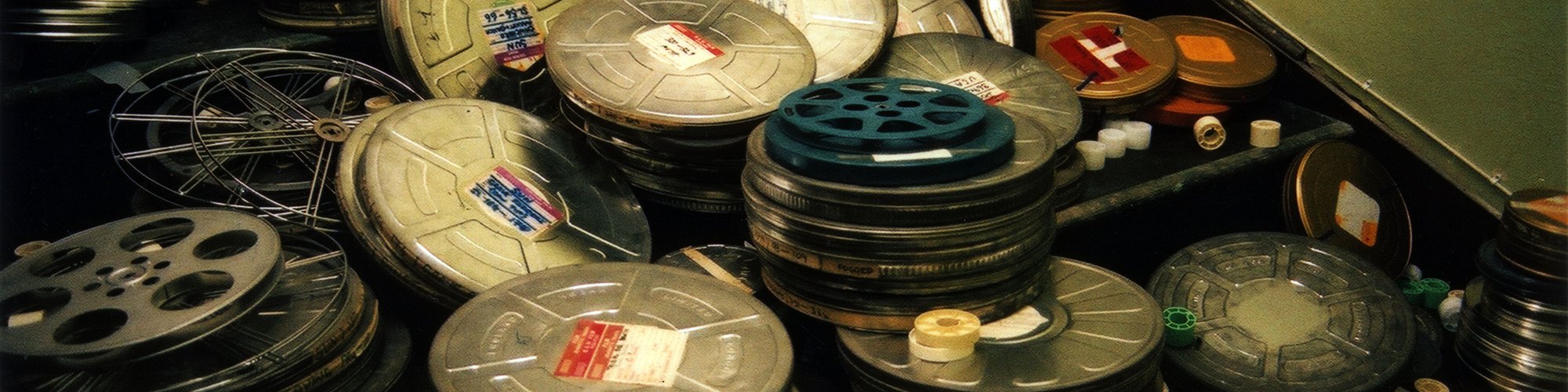
The former Museum of Mankind was a location we had looked at many times with different artists. One of its prosaic spaces was an old viewing theatre and adjoining rooms, piled high with dusty canisters: the Ethnographic Film Library. Atom imagined how all 2,000 feet of celluloid - the single take we had watched in Toronto - might be pulled around the auditorium through a forest of bobbins and sprockets, powered by the motor of a lone Steenbeck, without any idea how long the image nor the sound of Krapp's voice would survice this incessant looping.
Visitors were shown up a darkened staircase into the projection booth, from which you could just about make out the Steenbeck in the room below. Further exploration uncovered an assortment of cluttered back rooms until you were confronted by Krapp again, this time as a voluminous DVD projection – pristine, digitised and immortal.
– Michael Morris, June 2002
Image: 2000 feet of film, moving precariously and continuously around the room made up part of Atom Egoyan's Steenbeckett installation in 2002. Photograph: Thierry Bal
Atom Egoyan
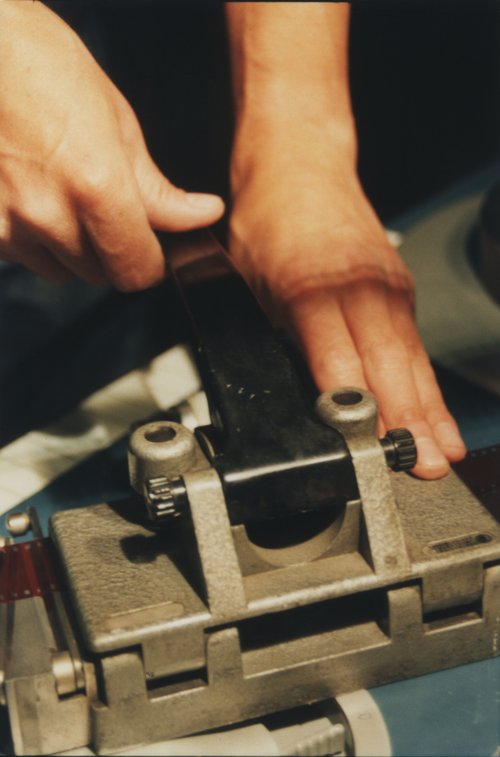
Atom Egoyan was born in Cairo in 1960 and grew up in Victoria, British Columbia. He moved to Toronto in 1978. A prolific practitioner, he has made work for opera, the visual arts, television, theatre and cinema including installation pieces for the Oxford Museum of Modern Art, the Irish Museum of Modern Art in Dublin, the Venice Biennale (in collaboration with Julião Sarmento) and Le Fresnoy. Feature films include; Chloe, Exotica, The Sweet Hereafter, Felicia’s Journey and Ararat. Opera direction include; Salome for the Canadian Opera Company and the world premiere of Gavin Bryars’ Dr Ox’s Experiment for English National Opera. The Sweet Hereafterearned Egoyan an Academy Award nomination and also won three awards at Cannes in 1997 and another two of Egoyan's films have since been nominated for the Palme d'Or. He has also received many other accolades such as the Toronto Film Critics Association Award: Best Canadian Film, The Independent Spirit Award: Best Foreign Film, Cannes Film Festival: Grand Prix du Jury and the Dan David Prize for "Creative Rendering of the Past".
Atom Egoyan, on working with Artangel
Working with Artangel has been an exceptional experience. Every step of the development of Steenbeckett has been a true collaboration, with ideas and concepts being clarified, challenged, nurtured and finally realized. I always felt that the every possible path we might have walked down was carefully researched and fully explored.
Steenbeckett involved a complicated negotiation of rights, both in terms of the literary property, and the securing and preparation of the location. The staff of Artangel were exceptionally dedicated and well-experienced in securing permissions, and organizing all the things to make this experience an amazingly rich and satisfying artistic experience.
Steenbeckett was produced at an extremely busy time in my life. I was simultaneously directing an opera and in the midst of finishing a feature film. Artangel was able to accommodate my schedule, and was completely understanding of my needs. This has been an extremely gratifying and memorable journey, and I am indebted to the vision of Artangel in making this possible.
In fact, Artangel can make anything possible!
Egoyan's sombre imagination and unsettling sense of space make his commission by Artangel a sensual goodbye to cinema. – Jonathan Jones, The Guardian
Film directors who make installations often seem to splash fake significance everywhere. But Egoyan's sombre imagination and unsettling sense of space make his commission by Artangel a sensual goodbye to cinema. – Jonathan Jones, The Guardian, 16 February 2002.
In his recent novel Slowness, Milan Kundera suggests that people slow down to remember and speed up to forget. This evocative notion, conceiving of memory as a place to linger in or avoid, finds fruitful embodiment in Atom Egoyan's new Artangel commission Steenbeckett. It's an ambitious work, marrying footage from his film version of Samuel Beckett's monologue Krapp's Last Tape with the technology of image delivery, in this case the Steenbeck celluloid-editing deck. That this installation, the filmmaker's first fully site-engaged initiative, is realised in the empty interior of London's former Museum of Mankind, an ethnographic collection that once displayed the collective memories of the species, underscores the negotiation between different elements that characterises Egoyan's work – Gareth Evans, Sight and Sound, March/April 2002.
'Behind every hot new working computer is a trail of bodies’, writes Steward Brand in The Clock of the Long Now (1999): ‘… extinct computers, extinct storage media, extinct applications, extinct files.’ Atom Egoyan’s Steenbeckett (2002), installed in the former Museum of Mankind in central London, addressed this issue of technological obsolescence, taking Samuel Beckett’s Krapp’s Last Tape (1958) as its starting point and muse. In Steenbeckett, Egoyan’s own film of Beckett’s play was employed as one of several linked elements which he framed and reframed in a complicated meditation on the nature of memory, technology and the preservation of the past. – Peter Suchin, Frieze, Issue 67, May 2002.
For Artangel
Co-Directors — James Lingwood, Michael Morris
Head Production & Administration — Antoinette O’Loughlin
Project Manager — Melanie Smith
Press & PR — Samira Kafala
Artangel Publishing — Gerrie van Noord
Development Associate — Natalie Kancheli
Finance Manager — Milly K Momin
Admin and Project Assistant — Francesca Laws
Admin Assistant — Corinne Micallef
Interaction Associate — Kathy Battista
For Steenbeckett
Site Manager — Deklan Kilfeather
Assistant Site Manager — Matt Bickley
Film Loop Assembly — Tom Hood
Carpentry — Jo Tipal
Design Fabrication — Shanti Freed
Invigilators — Antonis Bogadakis, Ben Borthwick, Phoebe Greenwood, Barry Hobson, Nina Krieger, Kristi, Louise, Lucy, Claude Neron, Aviva Schultz, Anthony Silvester, Gemma Starkey, Heather Ward.
With thanks to:
Dean Baylis; Jon Edwards; David Gordon; Marcy Gerstein; Egofilmart; A and C Audio; Blue Angel Films; Panavision; Parallel Films; Salon Rentals; Soho Images; Techniker; Technicolor; The Tape Gallery; Mel Worsfold
Image: Atom Egoyan, Steenbeckett, 2002 installation at the former Museum of Mankind. Photograph: Thierry Bal
Credits
Commissioned and produced by Artangel, courtesy of The Royal Academy of Arts and The British Museum. The project was supported by Arts Council England, Special Angels and The Company of Angels, and was made with the kind permission of The Estate of Samuel Beckett.
Steenbeckett is included in The Artangel Collection.