
In The Artangel Collection
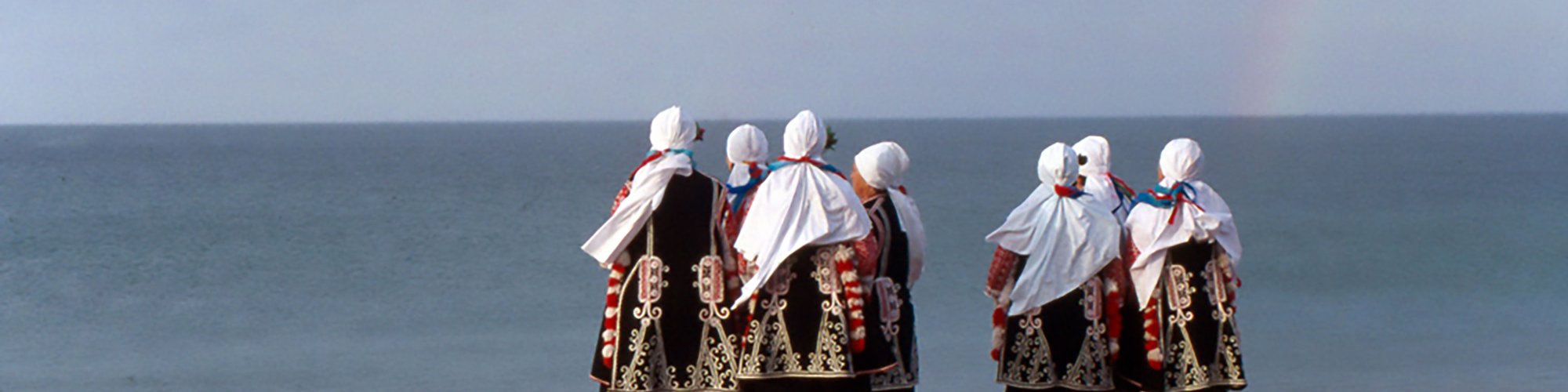
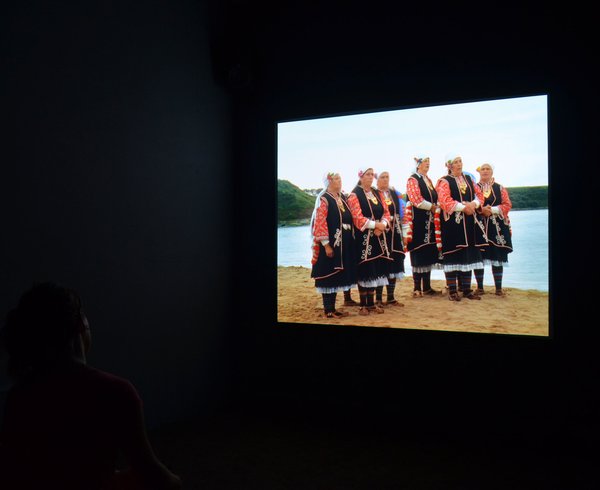
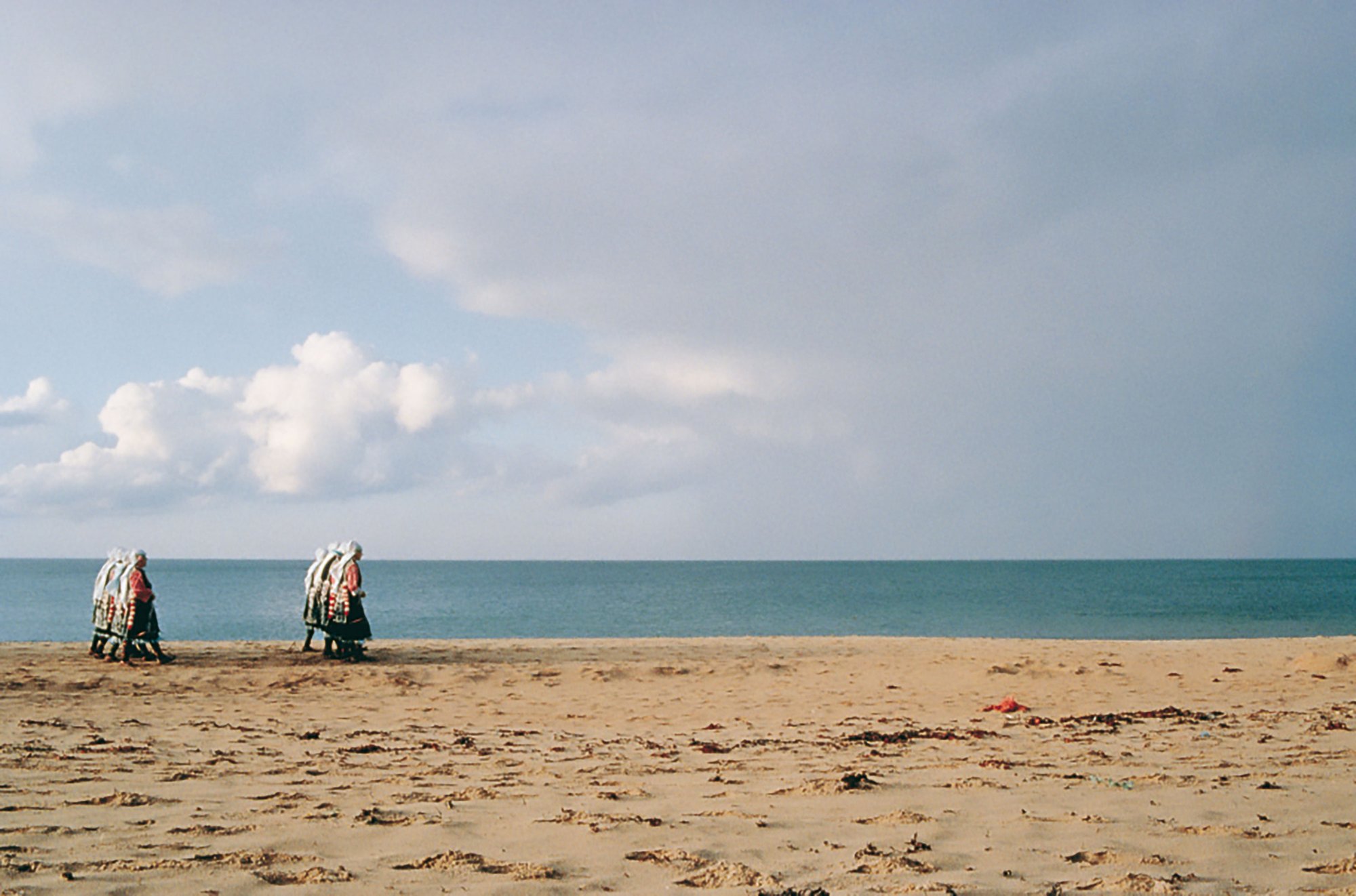
The Bistritsa Babi: A Work for the North Sea was a sequence of live performances and also a 12-minute 16mm colour film, Singing for the Sea.
The digitised version of this film— capturing the haunting antiphonal singing against the sounds of the weather and the waves with juxtaposing sequences of the Bistritsa Babi and close-ups of the sea—is available to loan.
Register your interest
Fill out the form to find out more about how you can borrow and present these works, including tech specs, use cases, and more.
Longing
By Ulrich Loock, Porto, 2003 – 2004
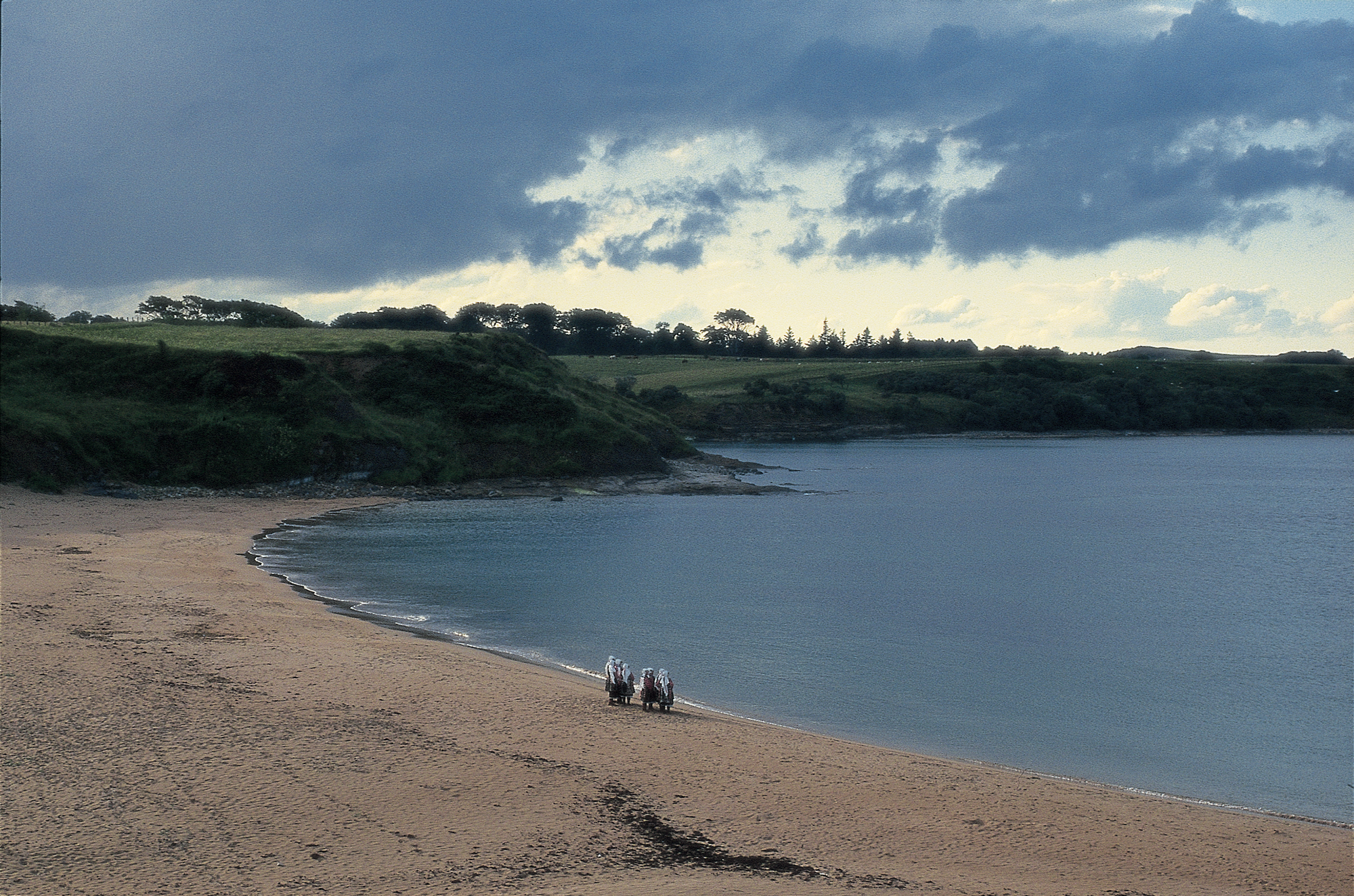
Ten years ago I travelled to Northumberland in north-east England, for the performance of a piece by Bethan Huws. I had never been there before, nor have I been there since. I don’t remember the journey. It was a bright day, but without the shadows cast under a cloudless sky. I arrived in the small town a few hours before the set time. There were few high buildings, as is to be expected in a place near the sea. Without stopping in town, I set off on foot and soon came to a rural area. It was the most beautiful countryside I have ever seen. I followed a path between low, close-set hills, which were nevertheless high enough to limit the view into the distance. I crossed a stream; everything was covered with grass, the colour of which I could no longer name. I seem to remember thinking that what I was looking at was the epitome of a meadow. In the green pastures sheep with light-coloured, almost white fleece were grazing, and there were solitary, quite tall deciduous trees. I don’t know whether I actually saw a dark grey castle there, or if it was somewhere else, maybe even in a picture. It wasn’t all that far away, but still too far to go and take a closer look at it.
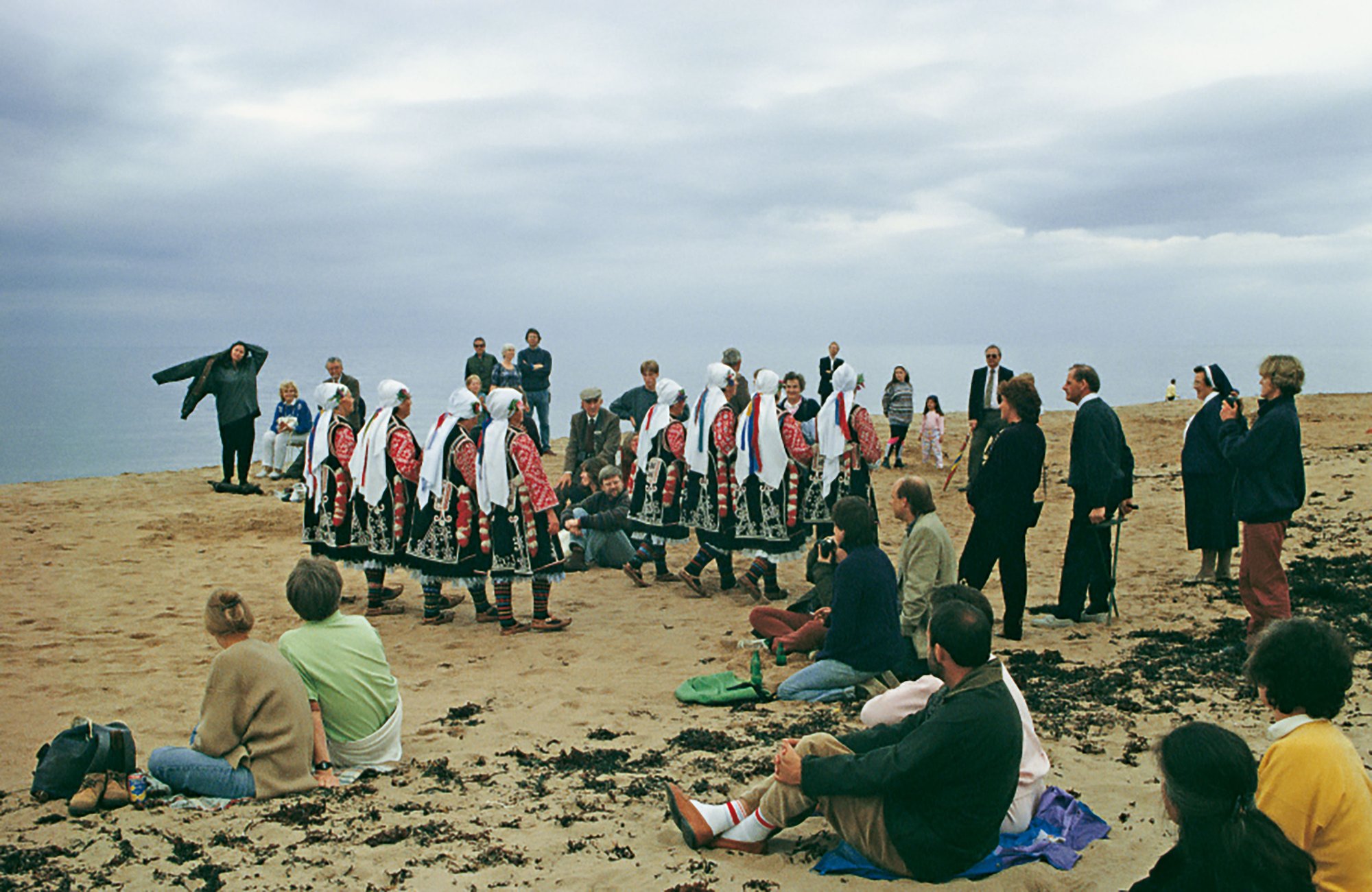
Image: The Bistritsa Babi in A Work for the North Sea by Bethan Huws, performed on Sugar Sands, Northumberland, July 1993. Photograph: © Bethan Huws
Remembering
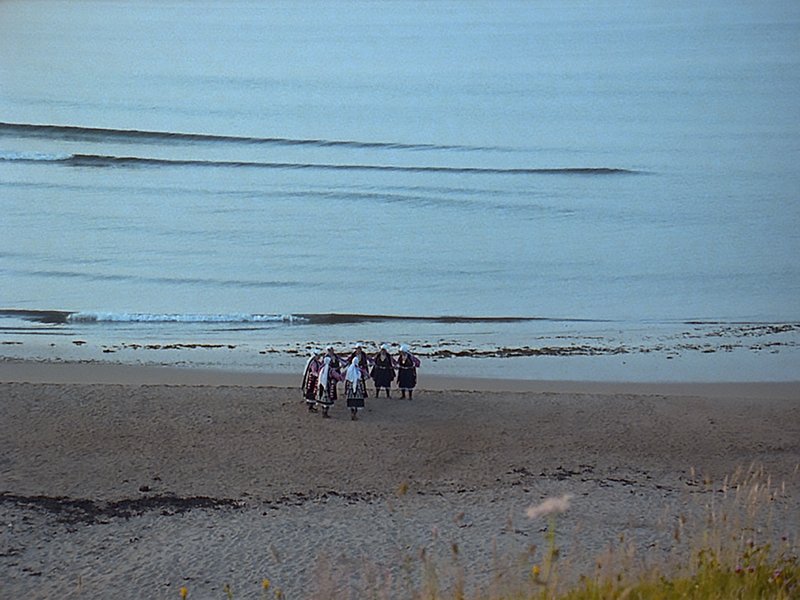
It happened ten years ago, but I can still remember it clearly. The danger, in fact, is that I shall merely repeat what I wrote at the time. Although it had rained heavily during the day on which I saw The Bistritsa Babi: A Work for the North Sea, the weather had cleared to leave a fine, still evening, interrupted by a few brief showers. We had all been told to gather in a car park in the town of Alnwick. From there, a bus would take us to the place on the nearby coast at which a performance by the Bistritsa Babi was to occur. On the way to the sea I looked down from my seat on the top deck of the bus and saw some people swimming in a river. Such scenes are very rare in Britain. After a short journey, the bus stopped at the end of a lane and we were told that we would have to walk the rest of the way.
Making The Bistritsa Babi: A Work for the North Sea
Bethan Huws in conversation with James Lingwood, London, 18 May 2004
James Lingwood: When did the work begin to take shape in your mind?
Bethan Huws: It began with your invitation to the TSWA – Four Cities Project in 1989, so it was some years before the work was actually made. I followed the spirit or logic of the title: the Four Cities Project. It inspired me, the vast vision it conjured up in one's head like the title of Charles Dickens' book A Tale of Two Cities, it shares the same grandeur or largeness of vision. I then looked for what these four cities had in common. Derry, Glasgow, Newcastle and Plymouth are all coastal or near-coastal cities. What they shared was the sea. A first location was established for Long Sands, Tynemouth, Newcastle Upon Tyne and at that time we realised that the project would need more elaboration. It was then taken up by Artangel in 1991. This was the very beginning of the project. The notion of the sea and the city are conceptually linked, the vision of a liquid moving mass... of people.
JL: Juxtaposing two ideas of vastness – one made up of people, the other without people.
BH: Yes that's it, although not quite so straightforward.
The Bistritsa Babi
The Bistritsa Babi are a group of elderly women from a village, not far from Bulgaria's capital Sofia, who still perform the dances and antiphonic and polyphonic open air singing traditional to the Shoplouk region. They are regarded as an important component of the cultural life of the area and continue to promote traditional expressions among the younger generations, their song passed down from mother to daughter since the Middle Ages.
These women are among the few remaining representatives of traditional polyphony and the village of Bistritsa is one of the last areas in Bulgaria in which these traditions are still practised.
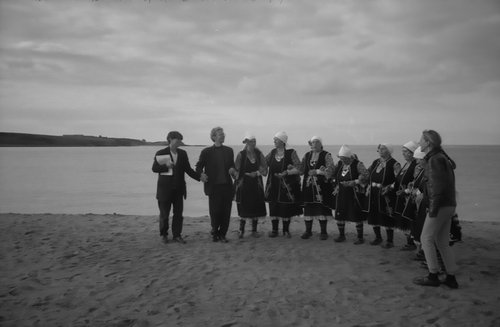
Those that participated in the 1993 performance and film with Bethan Huws were Krema Georeva, Tsvetanka Tsenkova, Dana Ovnarska, Dinna Ancheva,Nadejda Pachaliiska, Evdokia Batlachka, Gerginka Pachaliiska and Sevda Gergova.
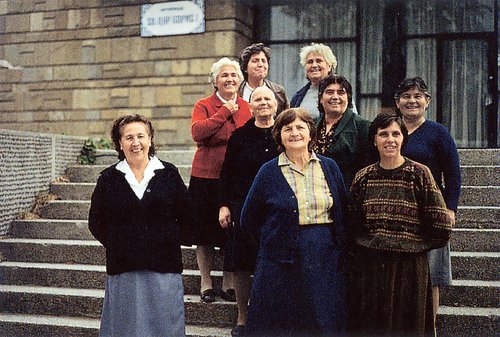
Images: (left) The Bistritsa Babi in A Work for the North Sea by Bethan Huws, performed on Sugar Sands, Northumberland, July 1993; (above) The Bistritsa Babi standing outside Bistritsa Town Hall, Bulgaria, 1992. Photographs: © Bethan Huws
The Sculpture of Song
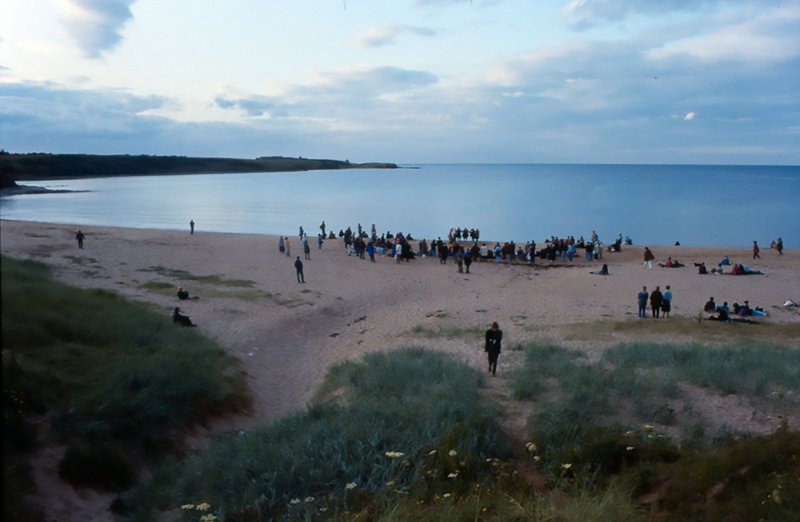
On an overcast but still day in July 1993, a group of travellers who had journeyed from across Europe to reach a remote spot on the British coast of the North Sea disembarked from their cars and coaches. They made their way along a narrow sandy ridge hugging the curve of the Northumberland coastline. Below the ridge lay a wide stretch of sandy beach. And on the beach stood a small group of women looking out to the horizon.
Read the complete essay.
Plato's Cave
The first time I saw Singing for the Sea was at an exhibition in Antwerp that had an unusually long title, starting with Vertrekken vanuit een normale situatie, and was curated by Yves Aupetitallot, Iwona Blazwick and Carolyn Christov-Bakargiev. It was 1993 and the exhibition presented the unequal structural composition typical of the time. This consisted principally in the fact that each individual work was of a different density, and the space occupied by the exhibition reflected this condition of unequalness, if you will permit the neologism. This makes the world an empty expanse, and the works of art are nuclei of meaning no longer contained within frames - or parergon, to use the term preferred by Kant and Jacques Derrida. As a result, the works expand or contract, no longer by virtue of their inner energy and within the bounds of a predetermined field, but only by virtue of their own - material and conceptual - compositions within the void. Consequently, the experience provided by that exhibition could be (alternatively or at the same time) light and trivial or testing and earnest. Significantly, Bethan Huws' film occupied its own separate space, which only came alive during the projection and had no apparent connection with the rest of the exhibition.
Read the rest of the essay.
Bethan Huws: Singing to the Sea
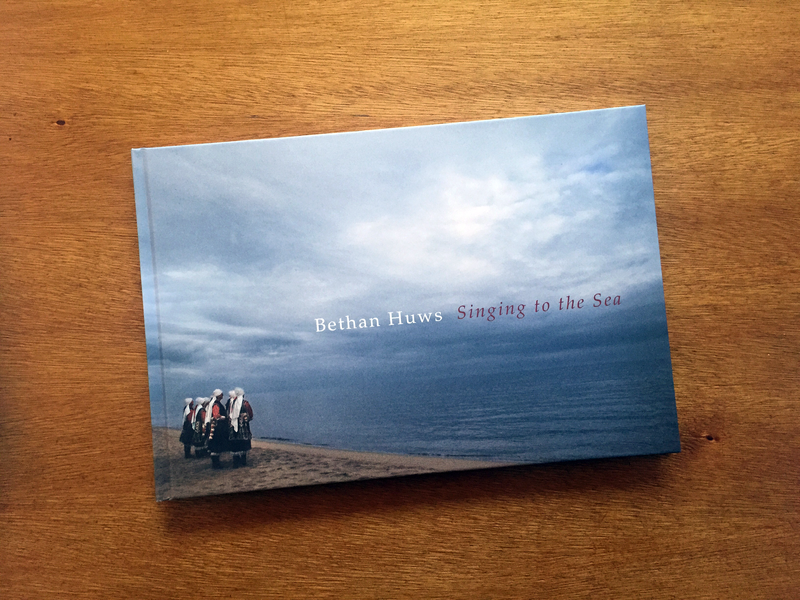
This book commemorates The Bistritsa Babi: A Work for the North Sea, an Artangel commissioned project by the artist Bethan Huws, which took place in Northumberland in 1993. Where the end of the land meets the edge of the water, eight Bulgarian women sang to the North Sea. The women were the Bistritsa Babi (Bistritsa Grandmothers), whose repertoire included traditional songs such as Vai Dudole (A Prayer for Rain) and Sultz Saide (for the Sunset). The work brought a tradition from the cradle of European civilisation to its Northern edge. It was the first visit of the Bistritsa Babi to Britain.
- Co-published by Artangel and Dieter Association, May 2006
- The book features essays by Michael Archer, Iwona Blazwick, Ulrich Loock and Pier Luigi Tazzi
- 80pp
- Hardback
- Black-and-white and colour photographs
- 215mm x 320mm
- ISBN: 9782952530408
Bethan Huws
Bethan Huws was born in Bangor, Wales, graduated from the Royal College of Art, London in 1988 and now lives and works in Paris, France. Her work often references language, particularly the titling of artworks, as well as the position of artists and she works across mediums in film, sculpture, written texts and readymades. Her work as beens exhibited internationally, solo exhibitions include the Kunsthalle Bern, ICA London, and Chapter Arts Centre, Wales. Huws was the recipient of the Henry Moore Sculpture Fellowship at the British School at Rome, the Ludwig Gies-Preis für Kleinplastik der LETTER Stiftung, Cologne and the B.A.C.A. Biannual Award for Contemporary Art in Europe, the latter accompanied by an extensive retrospective exhibition at Bonnefantenmuseum, The Netherlands 2006/07.
Images: (left) The Bistritsa Babi in A Work for the North Sea by Bethan Huws, performed on Sugar Sands, Northumberland, July 1993; (above) the artist Bethan Huws, James Lingwood (second left), The Bistritsa Babi, and Iwona Blazwick (far right) during production of A Work for the North Sea, 1993. Photograph: © Bethan Huws
Northumbria's strong folk-singing tradition may have created a sympathetic audience, but it was understood that this was not intended as a folkloric event. — Robert Hewison, The Sunday Times,1 August 1993
The song is then, more often than not, pressed back and forth between tow groups of four Bistritsa Babi. The random drone, along with the polyphany of the backing singers, gives the song a melancholic density which is sad and fatal, and at the same time transcendental. — Gregor Muir, Frieze, issue 12, September/October 1993
Northumbria ’s strong folk-singing tradition may have created a sympathetic audience, but it was understood that this was not intended as a folkloric event. — Robert Hewison, The Sunday Times, 1 August 1993
The women sang antiphonally, first one group of four, then the other, back and forth. The prevailing tone was the kind of harsh harmony, once so strange to the modern European ear, which turn-of-the-century folk-music enthusiasts used to collect and then doll up for concert consumption - but which now gets performed and broadcast in authentic form. — Tom Lubbok, The Independent, 3 October 2011
Credits
Originally commissioned by Artangel, assisted by the New Collaborations Fund of the Arts Council of Great Britain Northern Arts, Balkan Bulgarian Airlines and Antwerp '93. With thanks to Alnwick Playhouse and Alnwick International Music Festival.
Artangel is generously supported by the private patronage of The Artangel International Circle, Special Angels, Guardian Angels and The Company of Angels. Singing for the Sea is included in The Artangel Collection.